Paper
Paper And Wine Labels:A Brief History & Notes On Authenticity
By: Michael Egan
This article will deal with the evolution of papermaking and the logic behind the processes that determine the authentication of the paper of wine labels.
Regardless of the raw materials used, the basics of the papermaking process have remained unchanged for centuries. The raw material is shredded and then pulped in a solution in order that the cellulose fibres are separated out. Bleaching agents are then added. The fibres are then beaten until they are flattened and frayed, ready to be bonded together.
This pulp is then diluted in water, and fillers (clay or talc, for example) are added so that they literally fill in the spaces between the cellulose fibres. This is called sizing. Sticking agents are also added. These ensure that the resultant paper is not too absorbent. The solution is poured onto wire mesh (or the wire mesh is dipped into the solution) and when the water has drained out, the residue that remains on the mesh is the newly formed sheet of paper. The sheet is then pressed and dried. Charges (agents to smooth out surface irregularities) are added during the pressing and drying process. Proper mechanisation of this process, where continual sheets of paper could be formed, began with the Foudrinier machine, which was invented by Louis Robert at the end of the 18th century. This new process ensured that from the mid-19thcentury, papermaking became prolific and therefore cheaper, which resulted in a publishing boom.
Before the 1850s, paper was made from pulping fibres recovered from old cloth, flax (linen), and hemp. At this time, paper was made by hand – an expensive, time-consuming, and laborious process, which entailed sorting the rags, cleaning and heating them in an alkali solution, macerating them to a pulp, and then bleaching them.. However, paper made in this way has good longevity and is robust. After the 1850s wood pulp became a constituent of paper and gradually replaced the other ingredients. Today, only about 1 per cent of paper is made from fibres other than wood pulp.
For centuries, the identification of wine vessels and bottles relied on handwritten parchments tied around the necks. For bottles, a more sophisticated solution appeared in the application of an embossed glass roundel or other shape on the shoulder of the bottle. The initials of the owner were embossed as early bottles, being expensive, were reused. Generic wine names such as “Madeira” or “Sherry” were also embossed. As bottle shapes evolved, they became cylindrical and therefore could be stored horizontally in a bin. For identification, ceramic or metal labels were created to identify the contents of each bin. These again were usually generic; i.e Bordeaux and Burgundy.
The first paper wine labels made their appearance in the latter half of the 18th century. These were small and rectangular in shape. I have come across several, notably on some bottles of Rüdesheimer 1748, which I inspected and catalogued in a German castle. These probably were applied to the bottles 30 or 40 years after the vintage. Before the invention of lithography by Alois Senefelder in 1796, the first labels carried very basic information. Interestingly, a sheet of rectangular labels which had to be individually cut out is in the Musée Vaudois de la Vigne et du Vin et de l’Etiquette, Switzerland. It dates from the end of the 18th century and 6 different wines are named: Vin de Muscat de Frontignan, Vin de Malaga, Vin de Médoc, Vin de Graves, Vin d’Alicante, and Vin de la Côte Rôtie.
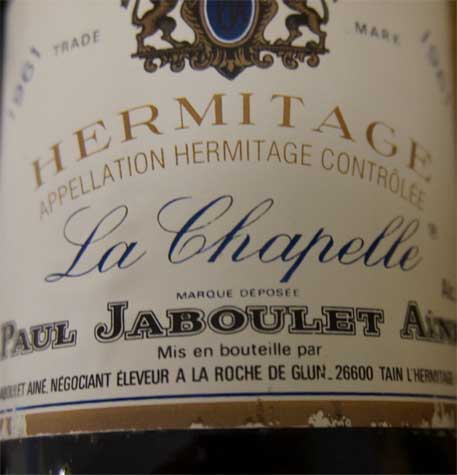
Counterfeit Printing Example – Jaboulet Hermitage La Chapelle
As lithography became more advanced in the 19th century, wine labels became larger and the printing more detailed, intricate, and colourful. This occurred in tandem with the plentiful production of cheaper paper.
Of course, the ideal is to confirm the authenticity of a wine label with a known genuine example. Failing that, there are various ways to determine the age and make up of the paper. The techniques, materials, and chemical processes used in papermaking have evolved and close examination of a wine label can determine its age.
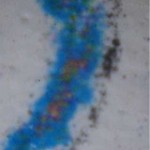
Jaboulet (Even Closer) Showing Clear Ink Jet Spray
As mentioned before, the appearance of wood fibres in old labels rules out labels made before the 1840s/1850s. Original wood-based paper was acidic due to the presence of lignin in the wood, which was not removed during the papermaking process, and also because of the use of alum-rosin, a sticking agent to render the paper less absorbent. Lignin decomposes and discolours.
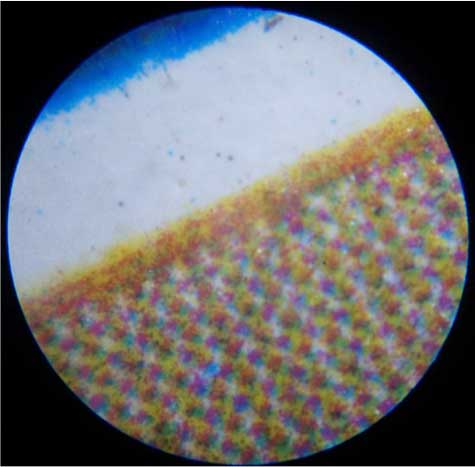
Jaboulet (Up Close)
Newspaper is made from lignin rich paper as it is cheaper to retain the lignin than to extract it. However, newspaper also discolours for this reason. Alum-rosin makes the paper very brittle. Therefore, the majority of 19th century wine labels on wine bottles are discoloured and fragile due to these two factors. Having seen many original 19th century labels, it was apparent when I came across a fake one. I was immediately suspicious of the robustness and extra thickness of the label on the fake bottle of Château Lafite 1811 that I inspected and testified at the William Koch v. Eric Greenberg trial in April 2013.
Clues as to the ingredients of paper can sometimes be relatively easy to detect. For example, paper was sized with alum-gelatine until the early 19th century. This wasthen replaced by alum-rosin, which in turn gave way to calcium carbonate, titanium dioxide, and other alkalis from the 1950s. A simple test for the pH of the label will tell if it is early (acidic) or later (alkali). Fluorescent whitening agents have been in use since the late 1940s and can be easily detected in paper by using black light, where they fluoresce.
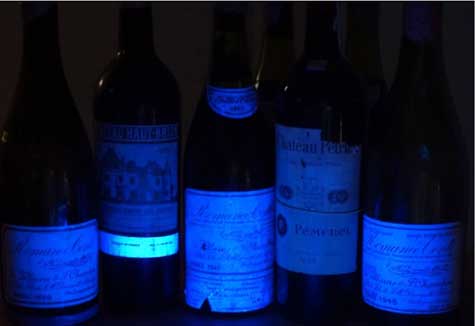
Paper Manufacture added a chemical to make paper whiter, after the 1960’s. Older paper should not fluoresce under blue light
One of the most famous counterfeit cases, Hitler’s diaries, which Stern magazine purchased from Gerd Heidmann in 1983 and which had been forged by Konrad Kujau, were proven to be fake as the paper contained optical brighteners of post-war manufacture. The ink was also found to be modern.
More involved testing can also be done to detect the amount of fluorine (from modern fluoride-added water), uranium content (detectable from mid-1950s onwards), latex or synthetic latex, and silicon, the latter being used to coat labels since the 1970s. Bleaching agents also have evolved. Sodium hypochlorite (household bleach) was extensively used to bleach the wood pulp until the 1930s when chlorine gas replaced it. These can also be forensically detected. Dating markers can be seen in the wood fibres, pulping chemistry, paper additives, and surface treatments when paper is tested in a laboratory.
Wine labels are made from a great variety of paper stocks. The paper has to be thick enough to support adhesive on one side and for this adhesive not to show through. Exceptions to this may be found in some Château Lafleur and Château Mouton Rothschild labels, where the bands of adhesive show through in an obvious manner. The paper has to be resistant enough to humidity and fungal attack and have a good wet-strength, particularly for white and sparkling wines, which may have to spend a long period in an ice bucket. Labels with cotton or linen fibres, as used for historical documents, although more expensive to produce, ensure that the label will be very hard to tear and discolour. Many wine labels have lines impressed into the paper to emulate a linen finish. This effect was originally obtained by pressing the paper between sheets of linen cloth and is now done by passing the paper between engraved metal rollers. An example of such a label with regular horizontal and vertical lines can be seen on Henri Jayer bottles. Château Pétrus labels have lines in relief running either horizontally or vertically, depending on the vintage. Harlan Estate labels have sophisticated paper to complement the incredibly intricate label design. The paper has a raised impression to give it a distinctive feel.
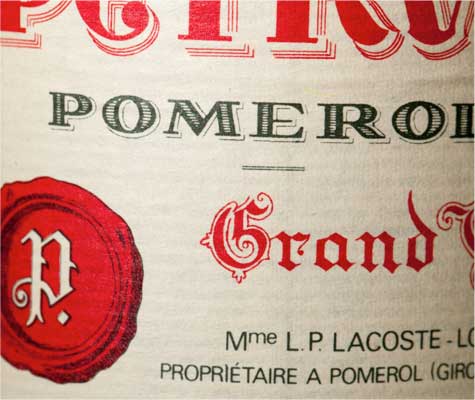
Château Pétrus Thick Paper Stock with Ribbing
As an added security measure, some properties have watermarks within the label. A watermark is created during the papermaking process when the solution is laid out on the mesh of the paper mould. A wire pattern is attached to this mesh so that when the paper is drained of water, the layer of residual fibres over this raised pattern are thinner than those on the rest of the sheet. When pressed and dried, these thinner areas of fibre show the pattern when held to the light. Château d’Yquem has a watermark in all its labels since 1984. The watermark can be viewed easily because it is a white wine. Watermarks can also prove useful in counterfeit cases. Thanks to the manufacturer’s watermark that I detected in some of the fake labels that Rudy Kurniawan had printed professionally, it was confirmed that the paper had been made by an Indonesian company; Concorde. This paper was used to make fake labels for Château Lafleur, Château Pétrus, and Domaine Roumier.
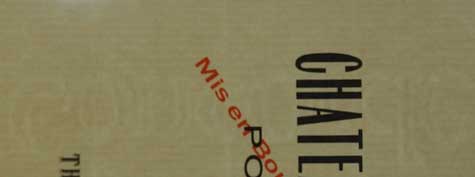
Kurniawan CONCORDE Paper Watermark.
Given the great value of top wines made today, there is a sound argument for wine labels to be made from security paper as is used in currency and bonds. This paper is a woven fabric containing such items as phosphorescent fibres that can only be seen under black light, metallised threads, and taggants added in the coating or base paper. Taggants are chemicals that act as a unique “DNA” that have to be decoded using a special process. Much progress has already been made in ink technology, especially the introduction of inks that only show up under ultraviolet light in order to render each label unique. Another security method is to scan the same section of every printed label and link it to its unique number. The scanning process links the number and shape of the fibres, which fall in a unique pattern on each label. This could provide a simple solution to the evergreen problem of how to render each bottle unique.
Synthetic polymer labels, as used in the pharmaceutical industry, are also ideal for wine labels as they are waterproof and resistant to the heat of digital printing. Moreover, the print goes deep into the substrate and becomes indelible and unalterable.
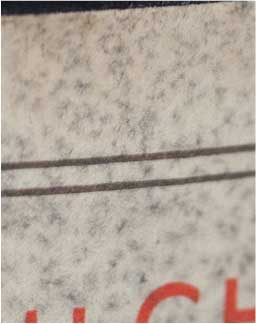
Counterfeit Applications Mimic Mold
During cellarage, the paper on the label can document the storage condition history. Significant humidity will first stain the surface and speed oxidation and discolouring of the surface. Prolonged exposure to high humidity will cause water saturation of the fibres, replicating the first stage of the pulping process. The label will tear easily and, even if not handled, the water saturation will cause the label to decompose and become illegible, finally coming off the bottle in soggy clumps. Mould accompanies high humidity and can completely cover the surface and eat into the paper. Mould comes in an astonishing variety of forms and colours from my experience inspecting bottles in so many cellars. Like wild yeast, certain strains dominate the microclimate of a particular cellar. One of the most common is grey mould, which can completely cover the bottle in thick strati. Insect damage, such as silverfish infestation, will leave white marks in the paper. As in book pages, foxing, which is the hydrolysis and oxidation of the cellulose in the paper, can occur as brown stains in the paper. It remains to be seen how modern wine labels, with all their surface treatments, will show signs of ageing if cellared under correct conditions of humidity.
Counterfeiters such as Hardy Rodenstock and Rudy Kurniawan have taken great pains to emulate the way old labels look. Their methods have included staining the counterfeit labels with dark liquids, placing labels in a heated oven to discolour the paper, applying shellac onto the label as a colourant, rubbing dirt on to the surface and also rubbing at the surface itself to distress the paper, and tearing the label at random points. This disguising is superficial as these treated labels do not have the patina of labels that have undergone years of storage in natural cellar conditions.
Floodwater, if the immersion is brief, will generally not affect the paper if it dries again quickly. Labels can come off, hence the method used to remove labels from bottles by immersion in water without damage. Silt from floodwater will damage the paper and leave staining. Smoke from fire will generally leave a greasy deposit on the paper surface and is readily identifiable – very important in detecting fire-damaged stock.
The evolution of papermaking now offers many solutions to the inherent problems found in wine labels: fragility to humidity and therefore loss of identification and susceptibility to being counterfeited. The last 3 decades have seen a big change in print technology, from the rotary letterpress in the 1980s to the flexo press in the 1990s, the UV Flexo in 2000n and digital printing from 2005 onwards. The paper industry has introduced sophisticated processes and additives to accommodate these new printing techniques.
General and Historical Information on Paper
Guest Contributor: YPB Group Systems
A global provider of paper and print covert brand protection and anti-counterfeiting technology for brand owners.
History
The Chinese first invented paper during the Han Dynasty (200 BC) and it spread to Europe via the Silk Road. Before it was used for writing paper, it was used mainly for wrapping luxury objects for royalty. It wasn’t until the 19th century that the combined innovations of the pencil and wood-based paper that printing on paper became widespread. It wasn’t long until printed-paper labels for brands began to be used on products, and with this innovation came the rise of the counterfeiting of paper. It is a common misconception that counterfeiting paper labels began only during the age of inkjet printing. Today, paper is mostly a byproduct of the lumber industry. There is also a misconception that producing paper is eliminating trees. Most trees that are being used in the paper industry are farm raised. The fact is more trees have been planted today than in the last 100 years.
Uses
Can be used for writing, packaging, cleaning, and other industrial processes.
Aging
Paper naturally ages over time. Signs of aging can be wrinkles, creases, increase of the brittleness of the paper, rust, and discoloration, specifically white paper taking on more brown hues. There are many techniques to simulate natural paper aging such as using tea bags as a solvent.
Quality & Type
There are many different types of paper, but one way to categorize them is whether or not they are coated. Coated paper has a surface coating that has been applied to make the surface more receptive for the reproduction of text and images in order to achieve sharper detail and improved color density. Uncoated paper is typically used for business forms, flyers, books, posters, checks, newspapers, scannable documents, and packaging. Coated paper is generally used for more stylistic products like brochures, magazines, folders, book covers, and calendars.
Watermarks, Textures, Weight
Watermarks are identifying images that appear on paper as various shades of light are transported through them. There are many different textures of paper that may require different watermarks, such as ledger, railroad bond, vellum bristol, laser bond, and more.
Materials Used
Almost any species of tree can be harvested for paper. Common today are spruce, fir, and hardwood trees. However, many other products can be used as well depending on what consistency of paper one desires. There are certain papers that are made of bamboo, straw, flax, and jute fibers.
Regulations
The paper industry is very heavily regulated in the United States. These regulations range from emissions regulations to limiting the use of certain chemical compounds in the paper that may be dangerous to some people.
For pictures of labels made by Rudy Kurniawan, click here.