Greenberg vs Koch Trial: Part 2
By Siobhan Turner
Witness: Jamie Ritchie, Sotheby’s
Jamie Ritchie, of Sotheby’s was sworn in, and confirmed that he had been subpoenaed to appear, and was not there voluntarily. Mr Ritchie, with looks at times reminiscent of Alec Baldwin with a quintessentially English twist, is Senior Vice President, overseeing the Asian and American wine business. He was questioned by Moez Kaba, a handsome man with Omar Sharif-like eyes and startling cheekbones, who is a key member of Hueston’s team (and, some time later, left Irell & Malella with him to co-found Hueston Hennigan LLP). Kaba’s extensive pro bono work includes representing various women’s groups challenging the constitutionality of the Defence of Marriage Act.
Ritchie confirmed that, although buyers may inspect wines prior to auction, it is rare that it happens. The most he had ever seen someone inspect is 30 to 40, possibly 10 times over the 23 years he had worked for Sotheby’s. They rarely do so because they trust the information in the catalogues.
Ritchie confirmed that he had had interactions with Eric Greenberg, and had become aware in 2001 that Greenberg was interested in auctioning his wine collection. He had heard that there was a significant collection, but also that the source of some of these wines was Royal Wine Merchants. In the past, Sotheby’s had come across other wines from Royal and they “declined to sell”. This was salient because “whenever Royal was a source, you have heightened awareness for counterfeit wines”.
In April 2002, Sotheby’s was invited to visit his cellar, to meet with him and see the collection. Ritchie was accompanied by Serena Sutcliffe, worldwide head of Sotheby’s wine business. They spent two to three hours touring the whole (very large) cellar, and a significant proportion of that time in what Ritchie called the “trophy wines” section, which include pre-1950 magnums of Petrus, pre-1960 magnums of Lafite, Cheval Blanc 27, Margaux 1900 and others.
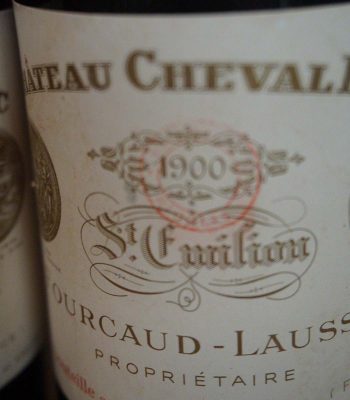
Counterfeit 1900 Cheval Blanc (6)
During this visit they pointed out some wines that might have been counterfeit – counterfeit labels, some with discrepancies between labels and vintage on the cork, and they “had a general discussion of counterfeit wines and wines that we would probably have difficulty accepting for sale without authentication by chateau”. In this discussion, they specifically pointed out wines to Greenberg – including discrepancies between label and cork, photocopied labels, and others that were problematic.
Kaba asked if they had opened and tasted the counterfeit wines before identifying them to Greenberg. Ritchie replied that this was not done, and that it was not necessary. Seeing a wine with a photocopied label was sufficient to ascertain that it was not authentic
Ritchie stated that he and Ms Sutcliffe had explained to Eric Greenberg that there were wines in his cellar that needed additional investigation, and that they could not select for sale what could not be authenticated. However, Sotheby’s was still considering an auction of his wine, because there was a lot of authentic wine they “would have been very happy to sell”. In order to proceed with an auction, they would have needed a list of wines for which they would provide auction estimates, agree the reserves. They would then need a signed consignment agreement. As part of the consignment agreement, they would expect information about provenance, which would indicate, inter alia, where Mr Greenberg had sourced his wines. They would specifically have wanted to know if Greenberg was consigning wines from Royal Wine Merchants, because of the heightened risk of counterfeit wine from that source.
After the visit, Sotheby’s prepared a proposal for Mr Greenberg, which would have included details of the catalogue, the marketing, the time-frame, the process and the financial terms, together with an introduction from Serena Sutcliffe. Despite the counterfeit wines, it was still an attractive cellar.
Sotheby’s prepared a draft consignment agreement, which was submitted for evidence, containing handwritten notes in Serena Sutcliffe’s handwriting. The consignment agreement contained representations that the seller has provided Sotheby’s with any information they have with respect to provenance, and that the seller had no reason to believe that any of the wines were counterfeit.
Jamie Ritchie noted that this consignment agreement must be signed before a sale with Sotheby’s could proceed. However, Mr Greenberg was not happy with it. He sent an email to Ritchie and Serena Sutcliffe, saying that the consignment agreement “enforces warranties on me which I will never assume”.
Following a second visit to the cellar, Eric Greenberg refused to sign the consignment agreement, and Sotheby’s did not sell his wine. Greenberg told Sotheby’s he was speaking to Christie’s because, in the words of Jamie Ritchie, “their estimates were higher than ours and they weren’t so concerned about the authenticity of wine, provenance of wine”. (Damning words…)
Ritchie eventually became aware that Greenberg was selling his wines through Zachy’s, including magnums of Petrus 1921, Lafleur 1945, 1947 and 1950, and other wines. Ritchie mentioned this to his colleagues because he was surprised to see these wines coming on the market, as they would not have offered them for sale without full provenance and authentication by the chateau, given the concerns Sotheby’s had about their authenticity, which had been expressed to Eric Greenberg.
Ritchie said that Greenberg was very unhappy when Sotheby’s told him about the counterfeit wines in his cellar. Ritchie then stated “Mr Greenberg said that if he did have any counterfeit wines in his collection, he could sell them through Acker Merrall because John Kapon (CEO of Acker Merrall & Condit) would take anything.” (See also Truly Hardy’s testimony in the Rudy Kurniawan trial). Mr Ritchie recalled this clearly, including exactly where in the cellar it was said, even 11 years later, because it was such an extraordinary comment to make.
Ritchie: cross-examination
Frank Cialone rose to cross-examine Jamie Ritchie. Another client of Cialone’s, Crazy Egg founder and web consultant Neil Patel, describes him as “like a pit bull. When someone messes with you, all you have to do is let him loose and he’ll take care of the rest. He’s very aggressive, and does whatever it takes…”
Cialone asked Ritchie to confirm that he had testified that Greenberg had said he was not as concerned with authentication or provenance. However, Georgia Chapin Carson (another Senior Vice President at Sotheby’s) actually said that it was provenance. Ritchie emphasised that provenance and authenticity are linked.
Cialone noted that Ritchie had testified that it was rare for a buyer to inspect wines. He then asked how often a single buyer bought $3.7 million worth of wine. Ritchie replied that that was rare – Cialone making the link that inspection might be rare but so was buying so much wine from one auction. Cialone asked how often someone was paid $75,000/day to lift the paddle for a buyer at an auction; Ritchie replied that he did not know, as Sotheby’s does not pay the agents.
Cialone then noted that there had been discussion about the warranties that Eric Greenberg had been asked to provide. The notation on the draft document seemed to indicate that Serena Sutcliffe had inserted the word “reasonable” before “reason” in saying that Greenberg had no reason to suspect that the wines were not authentic.
There was also a sentence in the draft agreement, where the seller promised to provide information regarding origins. Serena Sutcliffe had underlined this, and written “Does not know origins”. Ritchie emphasised that this meant Greenberg had stated he did not know the origin of all, not of any of the wines. This did not cause Sotheby’s to decide at that point they were not going to do business with Greenberg, although Ritchie emphasised that after the June visit to his cellar, the Sotheby’s team was fairly certain that they would not reach agreement. They had, in fact, left early.
Cialone noted that for several months they had pursued the auction; Ritchie emphasised that this was only through May and June. When Cialone said “you wanted to do an auction of Mr Greenberg’s wines, correct?” Ritchie replied emphatically, “Of the authentic wines”.
Ritchie confirmed that they had offered Greenberg a zero commission deal. He also agreed that he could not confirm how many bottles they had identified as counterfeit, nor could he recollect any specific bottles so identified.
Cialone then focused on the introduction that Serena Sutcliffe had written, in which she referred to the Greenberg cellar as “one of the great cellars of the world”. Ritchie agreed that “Eric had a great cellar”, but added that “if he had consigned inauthentic wines to us, we wouldn’t have kept them in the sale”. He agreed that, if this happened, it would not be referenced in the catalogue. Ritchie agreed that this had been written even knowing that there were counterfeits in the cellar, but although he did not know how much had been bought from Royal, he did stress that he at no time thought, as Cialone suggested, that it was as much as half to two-thirds of Greenberg’s cellar.
Cialone showed Ritchie and the court an email in which Eric Greenberg stated that the contract as proposed was not acceptable, because it did not include all the items listed in the proposal, and because there were warranties he could not accept.
Cialone then showed Ritchie and the jury an email from Serena Sutcliffe saying that Greenberg had wanted to change virtually every line of the contract, but adding that “our contracts are far, far too aggressively worded in comparison with Christie’s”. Greenberg was particularly upset that he was expected to warranty that the catalogue was correct, as prepared by Christie’s.
Cialone argued that Sotheby’s was proposing to put the catalogue together with glowing wording, and extensive national advertising, despite believing that the majority of the wine had come from Royal. Ritchie denied that they knew or believed this. Cialone suggested that he knew that a connection to Royal did not mean that the wine was counterfeit, which Richie accepted, but noting that it gave them a heightened awareness for counterfeit issues. There were also, as of 2002, other sources of counterfeit wine, including but not limited to Wine Library.
Cialone showed Jamie Ritchie a document with his (Ritchie’s) comments about the Zachy’s auction. Ritchie agreed that he had not seen the bottles that were in the auction, and that his opinion was based on the photographs, but added that it was also based on the visit to the cellar. Based on the visit to the cellar, Cialone argued, Ritchie had said they would need to do further inspection. Ritchie corrected him, to state that he had said “based on that, I said we would have required full provenance and authentication by the chateau in order to sell the majority of these wines”.
Cialone returned to Ritchie’s comment that Eric Greenberg had said that if he had counterfeits he could consign them to Acker Merrall because John Kapon would take anything, and asked “So Mr Greenberg was telling you that he intended to sell fake wine at auction?”. Ritchie replied “I don’t know what Mr Greenberg was intending to tell me. I’m just repeating what he said.” He refused to be drawn on whether Greenberg meant it or not; he simply repeated that it was an extraordinary statement (I’ll say!) which is why it was so clear in his memory. Cialone asked Ritchie how Sotheby’s could be happy selling wine from someone who intended to sell fake wine. Ritchie replied, repeatedly, that Sotheby’s was not intending to sell fake wine, and he did not know what Eric Greenberg’s intention was. However, he could not remember if Serena Sutcliffe heard the remark, or if Bob Sleigh (also of Sotheby’s) was even on the property. Cialone commented that this was strange, given Ritchie’s apparent clear recollection of Greenberg’s exact words.
Cialone then referred to the statement that Ritchie was there by subpoena and not voluntarily. Ritchie clarified that he had been willing to assist Mr Koch with the litigation, and had supplied Brad Goldstein, who was working for Bill Koch, with a list of wines most likely to be counterfeited and a database of wines that Sotheby’s has sold at auction. He had spoken briefly to Mr Koch’s counsel, but only the night before his testimony.
Ritchie also confirmed that Sotheby’s had done a full appraisal of Bill Koch’s entire collection, some time ago, and agreed that they proposed that he sell some of it. Cialone asked if Ritchie was aware that Bill Koch was a prolific collector of other things, which Ritchie agreed he was, and if he knew that Koch had sold a painting through Sotheby’s. Ritchie noted he had not been aware of that. He did agree that, as far as he knew, Sotheby’s is the only major auction house that Mr Koch had not sued. (Knowing Serena Sutcliffe as I do, I move that there is a good reason for this.)
Cialone then showed Ritchie an email between him and Serena Sutcliffe discussing the travel plans for the visit to Greenberg’s cellar, in which Sutcliffe wrote “so we get the whole morning with the little B, large B, actually”. He asked if Sutcliffe was calling Eric Greenberg a little bastard, to which Jamie Ritchie replied that he did not know. In his deposition, which he swore when questioned by Cialone was honest testimony under oath, he had said it “could be bastard or banana as far as [he knew”. (Personally, I have always found Serena Sutcliffe to be an astute judge of character.)
Cialone then showed a Wine Spectator article from 2010 showing that Sotheby’s had dropped from top of the US auction market (55% of the business) to last place (although second place worldwide, behind Acker Merrall). (I wonder what the numbers would be like if one counted only sales of authentic wines? Substantially different, I would argue.)
Cialone then argued that Sotheby’s would love to see Christie’s sell fake wines. (I think the argument here would be properly put that they would like them to be recognised for selling fake wines.) Ritchie disagreed, and was shown an email to him from Serena Sutcliffe in which she writes “I would love RB [Richard Brierley, at the time head of Wine for Christie’s in North America] to take a slew of DRC and Jayer fakes from him [i.e. Eric Greenberg]”. Cialone suggested that Sutcliffe had emailed Ritchie to raise the prospect of attacking the opposition and spreading rumours about the Greenberg collection on authenticity grounds. Ritchie agreed that she had said that if Greenberg did not give Sotheby’s the sale they should ruin it for anyone else.
Ritchie – redirect
Moez Kaba rose for the redirect of Jamie Ritchie. He first asked the witness to confirm that all of his testimony is truthful, which Ritchie did. He confirmed that Bill Koch was an important client of Sotheby’s, and that Koch had not asked Sotheby’s for assistance in detecting counterfeit wine on the market.
Kaba asked Ritchie if Sotheby’s would expect to know if another buyer had seen a bottle had not observed a vintage date on a cork. He replied that if they are looking at a bottle of wine, they like all the information about it, including others’ comments on potential inauthenticity.
Ritchie noted that, to his knowledge, Sotheby’s has never made material changes to the representations and warranties it demands of its consignors. If a seller is going to proceed with a sale of wine through Sotheby’s, he must have signed a consignment agreement, including that they had no reason to believe that any lot is not authentic. No catalogue was prepared for this sale by Sotheby’s because there was no consignment agreement.
Kaba noted that the suggestion had been made that he thought it was good for Sotheby’s if other auction houses are caught selling fake wine. Ritchie stated that he thought it is to the contrary: “We believe that we want a level playing field. We wish there is no counterfeit wine out in the market. We wish all of our competitors would not sell counterfeit wine.” He was troubled that the wine he strongly believed was inauthentic was being sold. Ritchie also testified that he had never before heard someone say that if they had fake wine they could always sell it through Acker Merrall. He confirmed that he had not repeated that comment publicly, nor told a reporter that Acker would sell counterfeit wine.
Ritchie: re-cross
Frank Cialone rose for one final question, asking Ritchie if the documents sent to Eric Greenberg after visiting his cellar reflected their honest assessment of his collection. Jamie Ritchie confirmed that they did.
Click here for Part 3.