Capsules
Capsules 101
By Michael Egan
The capsule, or foil, is the name for the covering at the top of the bottle that goes over the cork.
History of the capsule
Covering the top of the bottle is believed to have originated in the Middle Ages as a form of stock control, so that (good) wine could not easily be removed from the bottle and replaced with something less good, or, indeed, not a wine at all. It also served as protection from insects and rodents. The closure of the bottle at this time would normally be a plug of wood or paper wrapped in waxed cloth and tied down around the neck of the bottle. Cork was first used as a stopper in Spain and Portugal at this time, as the cork tree is native to these countries.
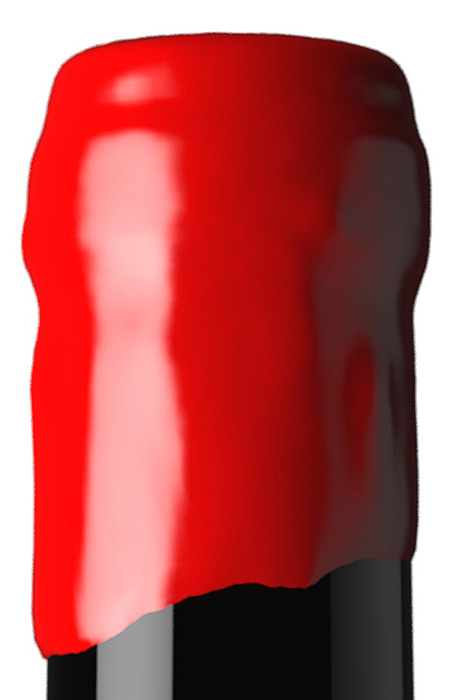
Wax Capsule
The metal capsule as we know it was first created in 18th Century Hungary, a lead seal created to protect wine from not only pests but also light and damp, and to provide some guarantee that the wine had not been adulterated.
Lead is an ideal medium to use as it is very malleable, and, therefore, exactly conforms to the shape of the bottle, ensuring a snug fit. This prevents cork weevil infiltration, for example. Another benefit with lead is that it is very effective in the prevention of floodwater coming into contact with the cork. It is resistant to corrosion (it is has been used in roofing and plumbing since Roman times) and thus can be an effective seal for decades.
Lead capsules began to be used in substantial numbers in the latter part of the 19th century and became more sophisticated with the addition of a trademark and name stamped onto the plateau and/or side. Early examples of this type of capsule can be seen from the Bordeaux négociant A de Luze et Fils. At the same time, very ornate lead capsules were produced in Germany for the top wine estates.
In Bordeaux and Burgundy, most early lead capsules extended about half an inch down the bottle. The longer capsules that we see today on modern Bordeaux bottles came into use generally in the 1950s. The early, shorter versions were useful as one could view the cork through the glass of the bottle neck without having to cut the capsule should the label become illegible or go missing.
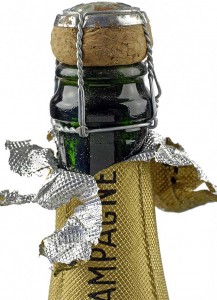
Champagne Foil Capsule
Changes in use and regulations over time
From the 1700s until the 1990s, lead was the “gold standard” (if you’ll pardon the pun) for wine bottle capsules, although some producers did continue to use wax. From a technical perspective, lead succeeded well, but in the latter half of the 20th century, its health impact raised questions. In the late 1980s, there was increasing concern, in California in particular, about the presence of lead in landfill, and California wine producers agreed to phase out lead capsules voluntarily by the end of 1992. In 1991, the US FDA released a report showing that lead levels in wine were well above those allowed for drinking water, and in 1996 it officially banned lead foils on domestic and imported wines.
As a result, starting in the early 1990s, producers shipping to the US (in other words, most high-end producers) progressively changed their foils to tin, aluminum, or polylaminate aluminum. There is growing use of plastic or PVC capsules, where even some high-end Napa Valley wine makers have utilized the plastic disc to cover the cork top.
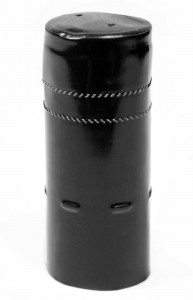
Plastic Capsule
The first plastic capsules appeared in the 1960s. Those that have survived from this era are generally not in good condition, having split or warped, and are usually now very loose. The use of plastic capsules nowadays is the norm for lower-end wines, given its cheapness. Some top Bordeaux Château now apply a clear plastic covering that extends over the metal capsule, for added security. Château Margaux is a good example.
Tin remains the preferred choice of most top-level producers, although the 293% increase in its price over the past decade ($6600/tonne in 2005; $19,350/tonne in 2015) has seen some switch to the much cheaper aluminum ($2110/tonne in 2015).
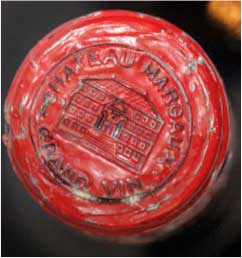
Chateau Margaux Branding On The Capsule
Expectations
A capsule should be cleanly and smoothly applied (old lead capsules could have creases that have been there since they were applied to the bottle) and its state of wear should match that of the bottle. It should be of a material appropriate to the age and quality of the bottle. The design of the capsule should be appropriate to the wine the bottle is supposed to contain, and to the legal regulations. For example, Italian wines later than 1963 will have DOCG labels around them. Finally, it should have appropriate branding for the wine which it is protecting. It is important, then, to know how the original capsules should appear for their era, given that there is usually an evolution in design and even colour.
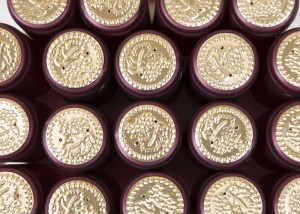
Grape Motif Capsule
Generic capsules
Not every wine producer or merchant has their brand or identification on the capsule. Many top Burgundy producers still use generic capsules. These can be blank or have an anonymous grape motif. Also, top Bordeaux châteaux that normally would have their brand on the capsule for their bottles and magnums may use generic capsules for their larger format bottles. Many bottles of Bordeaux and Burgundy wine have a crown on the plateau of the capsule.

Screw Top Capsule
What to look for
The first thing to check is whether or not the capsule does indeed relate to the wine in question. This sounds ridiculously simple, but counterfeiters are not always as sophisticated as one might think, and the wrong capsule can be a very easy way to tell it’s the wrong wine.
Secondly, check to make sure it is the correct capsule for the wine at the time. Is it magnetic, for example? If not, the capsule is almost certainly aluminum, and for most wines, somewhat suspect. However, be aware that top Bordeaux and Burgundy producers, when reconditioning a wine bottle, will use newer capsules, usually in tandem with new labels. If there is a logo, is it the correct one, and the correct colour, for the brand in question?
Are there any anachronisms? One rather fatal example is of a recycling logo on an early 20th century bottle. Winemakers can be visionary, but that’s beyond the pale!
Anti-counterfeit measures and technology
Anti-counterfeit technology has, to date, focused less on capsules than on other aspects of wine packaging, such as labels and the bottle itself. Nevertheless, some measures are now being implemented. These include holograms and, since 2012, QR codes.
To see pictures of Rudy Kurniawan’s wax and and stamps, click here.