Corks
The Significance of the Cork
By Michael Egan

Ancient Ephesus - Where Amphorae With Corks Have Been Discovered
We have used cork since antiquity in a variety of ways, for example, as flotation for fishing nets, footwear, and flooring. Cork has been connected with wine since at least Ancient Rome. Archaeologists have discovered amphorae with cork stoppers and remnants of wine at Ephesus. These date from the 1st century BC. However, by the Middle Ages, cork was no longer used as a stopper for wine vessels. Either oil was poured onto the liquid’s surface to prevent oxidation or a plug of paper or wood wrapped in waxed cloth was used to seal the opening. It was not until the English manufacturers produced sturdier glass for bottles in the mid-17th century that cork was considered again as a stopper. For cork to be an efficient seal, the circumference of the bottle neck has to be regular, so these bottles were suitable for its use. By the end of the 17th century, bottles were becoming slimmer and longer, enabling them to be laid down. The corks now enabled the wine to age as they provided a very good seal and were easy to insert and extract. Also, because the bottles were stored horizontally, the corks were in constant contact with the wine, so they did not dry out and loose their sealing capability.
Cork has the following useful qualities that make it ideal for use as a stopper in wine bottles:
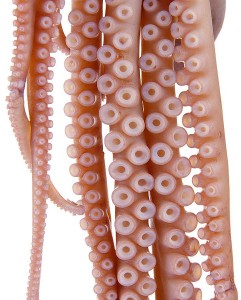
Octopus
- It is impermeable (it has also been used in life jackets and life buoys).
- Its compressibility is remarkable: it can be squeezed to half its dimension without expanding in length. New corks have a greater diameter than the host bottle. Once inserted, the side of the cork exerts a uniform pressure against the inner side of the bottle. It is also flexible enough to compensate for any small imperfections in the glass.
- It has a natural adhesive property. When corks are cut out from the cork bark during their manufacture, the slicing of the surface cells changes their shape akin to the suction cups of an octopus. Therefore, these cut cells that form the surface of the cork provide excellent adhesion to the wet and smooth inner surface of the bottle neck.
- It retains the above properties at low and high temperatures. Therefore, the natural temperature variation in a wine cellar will not affect the corks.

Cork Trees Recently Stripped, Alentejo, Portugal
Cork comes from the bark of an evergreen oak that thrives in the climate of the Iberian Peninsula.
The trees require the paradox of a low rainfall but a high humidity to grow well. These climate conditions occur in only a very few places on earth. The bark of the cork tree evolved to grow in thick spongy layers in order to provide insulation from the hot, arid winds. Although there has been success in introducing the cork tree to other continents, over 50% of cork production still comes from Portugal. There are also major cork tree plantations in Spain, France, Italy, and Tunisia.
As with the vine, one has to wait many years before the highest quality harvests can commence. However, for cork, the first harvest occurs only when the tree is 25 years old. Moreover, the outer layer of inert bark can only be harvested every nine years. Wine corks can only be produced from the third harvest. It is from this time onwards that the cells in the bark have the regularity and density necessary for wine cork production as the cells only then have the necessary pliability without leakage.
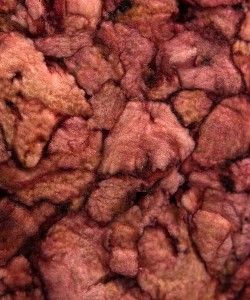
Texture of Cork
The cork bark is stripped away by hand and the resultant strips are stacked and weathered. There is natural moisture in the cork, which has to be reduced to a certain level. If it becomes too dry, the elasticity and compressibility is gone. The gradual drying process takes place at the cork factory. The bark strips are also sterilised by immersion in boiling water. This process flattens the strips as well so that they lose their natural contours. When dry, these strips are reduced to much smaller strips, the dimensions of which are equal to the size of the desired corks. It is the width of the bark strip that forms the diameter of the cork, not the length of the cork. Holes calibrated to the size of the bottle cork are then punched into the bark. The rudimentary bottle cork is thus created. The cork heads and bodies are polished so that they all have a uniform length and diameter. They are then washed and dried. Most are bleached in either chlorine or hydrogen peroxide in order to disinfect the cork, and some are just rinsed without bleach, depending on the client’s request. Nowadays, a final surface treatment is applied. Silicone and/or paraffin or a resin is sprayed or tumbled onto the surface of the cork. This treatment eases insertion of the cork into the bottle and improves the seal against the glass.
The process that I have just described is the most costly in terms of the quality of the material and man hours needed, and it is the one that is used in the creation of fine wine bottle corks. These corks need to have a life of at least twenty years in the bottle in order to be effective. Again, the density of the cells in the mature oak bark plays an important role in maintaining the elasticity; therefore, the snug fit of the cork in the bottle. This density also ensures that the cork is impermeable for longer.
In France, the accepted notion for the length of a fine wine cork is 5.2 cm as laid out in the charter of the Fédération Française des Syndicats de Liège. This is the federation of French bottle cork manufacturers. This is regarded as the optimum length for corks destined to be in a bottle for at least twenty years.
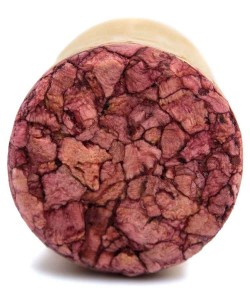
Bottom of Stained Cork
The elasticity, and, therefore, the pressure of the fine wine cork against the glass requires that the top of the cork that is against the capsule is in a humid atmosphere. If the storage conditions are too dry, the top of the cork will shrink away from the glass wall and eventually small channels will occur through which the wine will seep. This seepage through the cork and capsule can often be detected just by looking at bottles lying in their bin or rack. Abnormally low ullage levels are also an indication of inadequate storage conditions.
Normally, after twenty years or more in correct storage conditions of temperature and humidity, fine wine corks will gradually lose their elasticity and will shrink. They will also become more and more stained through the constant contact with the wine.
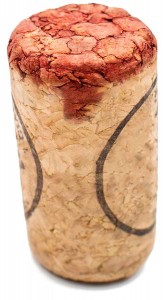
Upward Movement of Staining
The bottom of the cork obviously will be the most stained, particularly if in contact with red wine. This staining will gradually go up the cork towards the capsule. The lettering and digits on the cork will very often get closer together as the cork shrinks. In many instances, the branding will become less legible as the wine can make it fade. The degree of staining and other factors are important clues to determine whether a cork in a bottle of older wine is genuine or not. Older corks, although they are more fragile, normally require less of an effort to extract than young corks, given the shrinkage and consequent reduced pressure against the side of the bottle. They can also be reinserted more easily. This facilitates fraud. An old cork that has been successfully extracted with a “wiggle and twist” two-pronged corkscrew, leaving no telltale hole in the top, can be reinserted with little evidence that it has been manipulated. Sometimes this practice can be discovered when viewing the cork through the neck of the bottle as the imprint of the prongs can still be seen.
There are cases where the corks have lasted a remarkable length of time and have admirably protected the wine. I have opened bottles of Claret, Port, and Sauternes that were over 100 years old with their original cork and were sound. The viscosity in sweet wine and port slows down the seepage rate considerably.
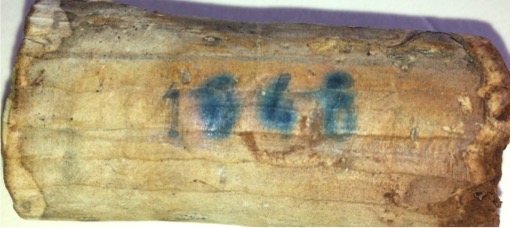
Ink placed over vintage brand to change date
Along with the capsule, the cork works as a seal and guarantee of the contents. To this end, the top Bordeaux châteaux and the majority of the Burgundy domaines have the wine’s identity and vintage marked on the cork. The traditional method is to actually brand each cork with the name and vintage and often the logo with a firebrand, although more and more corks now are printed rather than branded. For top Bordeaux châteaux up until the 1960s, the branding read horizontally across the cork with the vintage often branded at the very bottom. This meant that a significant portion of the cork could always visible through the glass as the capsules were shorter and did not cover the cork. This practise has proved very useful to determine the vintage of the wine when the label has become too bin-soiled to read or has come off. Of course, with this type of branding, the corks had to be inserted the right way up at bottling.
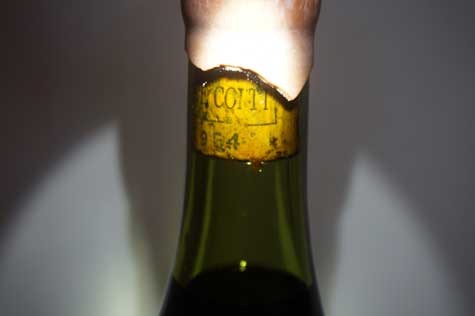
Rudy Kurniawan Romanee-COITI Cork Stamp
The majority of modern corks are branded vertically so that the writing and the vintage read along the length of the cork. In this way, it does not matter in which direction the cork is inserted. In more and more instances, the vintage is also printed or branded on each end of the cork. Counterfeiters have created rubber stamps with the name and logo of the château or domaine and also separate vintage stamps that they use to stamp blank corks.
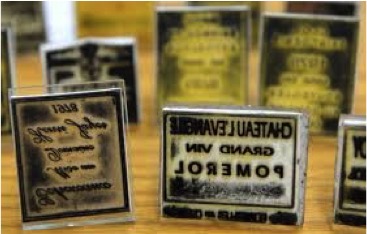
Rubber Stamps To Counterfeit Corks
This is a sophisticated technique, which has fooled the untrained eye into believing that the corks in counterfeit bottles are genuine. Actually, most of these fake corks look crude and inaccurate when compared to genuine branded corks. For authentication purposes, there is now the facility for a unique code to be printed on each cork, which is then photographed and entered into a database. As the natural pattern of little holes and cracks in each cork is unique, the visual scanning software links the code with the image of the cork. The argument is that when the cork is extracted, it can be scanned and the image compared with the one on the database to check if it is genuine.
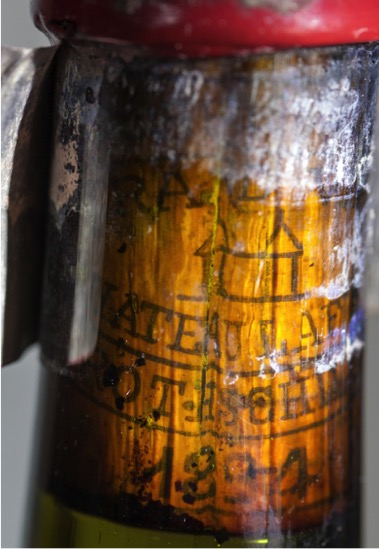
Reinserted After Altering Vintage
In the past, the adage was that corks had to be replaced every twenty-five years for fine wine. In the interwar years in Great Britain, recorkings were performed in the cellars of the great town and country houses either by the staff or by employees of such grand retail establishments as Army and Navy Stores. More recently, the wine company Whitwhams in Cheshire, Great Britain, recorked a significant quantity of fine wine bottles in the 1980s. The problem is always the same whenever any of these recorked bottles come onto the market: no guaranteed authenticity.
The value of such recorked bottles is slashed because of this potential authenticity issue. Recorkings have also been done by the great Bordeaux châteaux and Burgundy domaines. These recorkings have proven to be more commercially successful thanks to the perceived guarantee of the authenticity and condition of the wine. However, counterfeiters have made copies of these recorked bottles. It has been the practice for many years for the château or domaine to apply a new label and capsule when recorking old bottles for their clients. There is also often an indication that the bottle has been recorked by including the year of recorking on the new cork and/or on a label applied to the bottle. This practice has also made it easier for counterfeiters, who create clones of these reconditioned bottles.
One subject that has been much discussed concerning natural corks is the incidence of cork taint in a wine. This is caused by 2,4,6-Trichloroanisole (TCA). The received opinion is that this pungent compound is caused by the interaction of moisture, chlorine, and mold that can affect the cork during storage of the bark and its preparation prior to bottle cork manufacture. TCA from an affected cork leaches into the wine. Depending on the concentration of TCA, the taint can partially or wholly mask the normal aroma and taste of the wine. Severe taint is unmistakable, as it smells of damp cardboard and musty cellars. The problem is that this taint will not “blow away” in the glass, but will actually become more noticeable. The incidence of cork taint, although rare enough, certainly spoils the enjoyment of a bottle of fine wine. Most people in the wine trade have had multiple experiences of cork taint. The estimate of bottles so affected is between 1.5% and 5%. Recent advances in the production of bottle corks guarantee that there will not be any cork taint and some French cork manufacturers actually have this guarantee written on each cork.
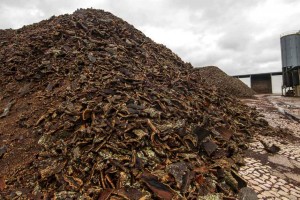
Cork Transformation Plant
This article has concentrated on the significance of corks made for fine wine and which are the highest quality, being made from one piece of carefully chosen cork bark. Bottle corks for wine destined to be consumed within a few years are made from either lower quality bark with more natural holes that can be filled and sealed with a mixture of fine cork grains and resins or agglomerated cork with a disc of cork bark at each end.
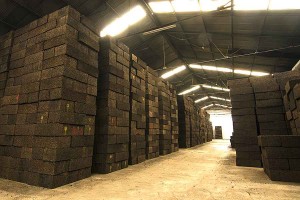
Cork Transformed into Blocks
Alternatively, synthetic corks are used for volume wine, negating the risk of TCA taint. The interior is generally made of a dual density foam core with a dense skin that has compressibility, emulating the natural cork. These can be removed with a corkscrew. However, they are not as easy to reinsert as natural corks. Long-term tests are still underway to assess the suitability of the synthetic cork for fine wine.
For pictures of cork brands made by Rudy Kurniawan, see here.