Labels
By Siobhan Turner
The label is the principal source of information about the wine for the consumer. It is usually made of paper with an adhesive holding it to the bottle, and will contain information such as the name of the producer and the wine, where it was produced, its alcohol content, and anything else that law or the producer deems relevant.
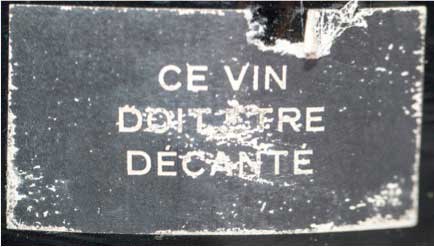
Counterfeit Etablissement Nicolas Decante Label, is a Sticker
There are two different principal forms of label: the front label and the back label. The “strip label”, additional information containing instructions about the wine (i.e. should be decanted) or detailing the importer, will also be considered here.
History
Front label
Although wine labels have been around as long as people have been trading in wine (in other words, at least as far back as the pharaohs of ancient Egypt), here we concentrate on labels for bottles of wine. In 1611 a group of Scots including Thomas Percival received the first patent for a coal-fired glass furnace, which dramatically changed the heat at which glass could be fired and, therefore, its strength. For the first time, it could reliably withstand transport, and wine could be shipped in bottles.
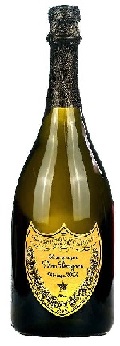
Dom Perignon Bottle
Wine bottle labels are first known to have originated with the Benedictine monk Pierre Pérignon (he of Dom Pérignon fame) in the early 1700s, who would hand-write labels on parchment and tie them around the neck of the bottles with string. Nevertheless, most wine was still sold in barrel, and identifying the barrel was the most important factor for purchasers.
As bottles became more reliable and thus more frequently used, labels became more important. Lithography, invented in 1798 and the most common form of quality printing today. Lithography enabled the mass production of wine labels, and permitted colour printing, and much greater detail. It was at this time that labels as we would now recognise them came to be printed. Nevertheless, it is important to remember that most labels before the mid-50s were merchant labels. Indeed, it was illegal in England to sell wine in bottles until 1860.
The treatment of paper also changed. In the mid-50s, paper quality became much better, and labels started to be made from bleached paper. Recycled paper came into use, but these lower grade papers are not used by the great producers.
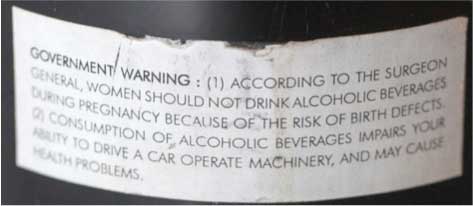
Government Warning Label
Back Label
Back labels are actually rarely used by the great producers of Burgundy and Bordeaux and, therefore, relatively rarely an issue, since it is these bottles on which counterfeiters tend to focus. These labels provide additional information about the wine, quite often a story about the vineyard, producer or the vintage, and often the legal information that must be included, such as allergen labeling (required in EU from 2012 vintage on), volume, ABV%, the name and address of the bottler, and any warning labels, especially if produced in or imported into the US. (Technically, the inclusion of this information makes it legally the front label, but we’ll ignore the lawyers for the moment and continue to refer to it as the back label.)
Importers may also apply their own labels to the back, particularly for French wines imported into the US. Martine’s Wines is a prime example – large back labels with the importer’s name and address, requisite government health warnings and the statement “contains sulfites”. These are considered below.
Strip labels
Strip labels are the labels applied by the importer of a wine, giving the importer’s name and address. If required, additional health warnings or similar information are included in the strip label.
US strip labels in particular are a negative factor in assessing a wine’s provenance, especially for European buyers, as it implies a return transatlantic journey. Octavian estimates this is worth at least a 14% discount.
Changes In Use And Regulations Over Time
A number of key changes have had a significant impact on wine labels. One of the most significant was in France in 1936, when Appellation Controlée was first designated for wine, initially in much of Bordeaux, Burgundy, the Loire and the Rhône. It has now been extended throughout most of France.
Domaine or Chateau bottling also changed the picture. From the 1924 vintage, all Mouton-Rothschild wine was chateau bottled, and this is, therefore, the first date from which “mise en bouteilles au chateau” should be expected on any wine. Most took much longer to adopt the practice – Margaux, for example, was still shipping in barrel until 1948, and much of Burgundy until the mid-1950s.
Expectations
Above all, a wine label must be consistent: with the condition implied by its purported age, with the condition of the rest of the bottle, with known manufacturing standards of the time, with the size of the bottle, and with regulations.
Paper should be of a standard expected of the wine and its time.
Labels pre-1957 would not have been bleached, so should not fluoresce under blue light.
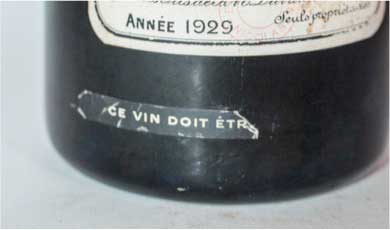
Be Sure To Understand Proper Aging Of The Label
Printing should be clear, consistent, and detailed.
If a bottle is showing signs of age, these should be consistent with expectations. (See Aging Techniques section)
A back label from the producer is unusual for the great domains and chateaux of France. However, these are often applied by the importer into the US. In this case, the expectations of consistency of this label are less than for the rest of the bottle, depending of course on when it was imported.
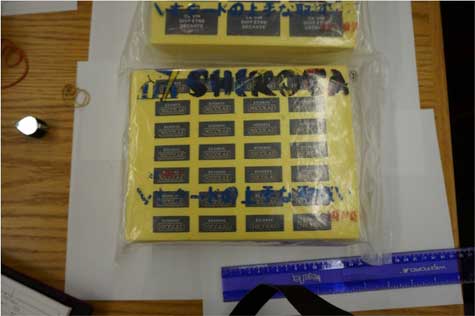
Rudy Kurniawan Bags Of Labels In Evidence - Stickers
What To Look For
The first thing to look for on the label is inconsistency. Typical inconsistency that can indicate fraud includes:
- Label being considerably more or less worn or aged looking than the capsule and cork;
- Main label showing different levels of age to vintage label (if present) or back label;
- Stains (or lack of) that are not consistent with the condition of the capsule; or
- Quality of paper or printing inconsistent with purported quality of the bottle.
Any significant inconsistencies should raise alarm bells.
It is also essential to look at clarity and quality of the printing. Forgers in some cases have managed to create a good-looking template to use, but because they will be working from a later generation imprint, it will lack the detail and clarity of the true label. This is particularly true, for example, in some of the very detailed areas. Look at the corners, at the small details that are not typically obvious. Is the lettering clear and defined. It should also be consistent (there’s that word again) with the time and expectations; first growth Bordeaux chateaux and grands crus Burgundies do not use ink jet printers.
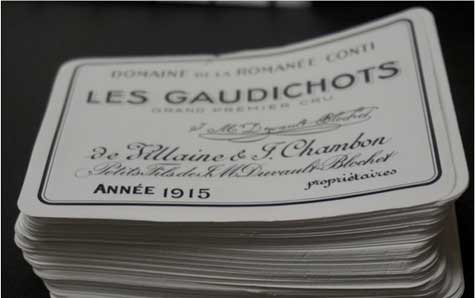
Stacks Of DRC Les Gaudichots Labels In Rudy Kurniawan Trial
Thirdly, it’s important to examine quality of the ink itself used, especially if it is metallic. It should show clear evidence of metal when closely examined – rather than simply a bronze or gold or silver colour, it should shine. Lettering should be well-defined, and even – dropped or overly slanted letters suggest it has not been properly printed.
Fourthly, if the label does have some age or damage on it, use your senses. If it’s showing signs of ageing, it should smell like old paper. If it smells like tea, coffee, or as if it’s been cooked, that is a sign of potential false ageing, and should raise alarm bells. If there is a tear on the label, run your finger along it. Most label tears are so-called “accordion tears” – caused when removing a bottle from a wine rack. These have distinctive folds and are hard to replicate by other means. Tears on the edges of the label, or where they obscure particularly important elements of it, should raise concerns. Glue stains around the label can indicate that the label was not the original one on the bottle – or not originally on this bottle.
There are some producers who make special labels, such as Mouton-Rothschild since the 1946 vintage (and for the 1924), and Barolo producer Vietti, the first 100 of which each year are signed by the artist. These are harder to counterfeit, but it’s nonetheless important to remain vigilant.
The final thing to consider, with particular relevance to strip labels, importer labels, etc. is the “noise” they create on the bottle. Much like a magician or, perhaps more relevant here, a pickpocket will create a distraction so one does not notice the sleight of hand, a counterfeiter will create a distraction on the bottle so that you do not notice that the actual label, or other aspect of the bottle in question, is not as it should be. They are also useful to create the impression of a special bottling with, of course, a different label that should not – according to the vendor – be expected to conform to one’s normal expectations. Strip labels are relatively easy to acquire and, because they are applied by the importer, often relatively simple to apply, so they are not necessarily in themselves good for sniffing out counterfeits, but their presence, especially in number, on a bottle should raise warning flags.
Anti-Counterfeit Measures And Technology
There are a number of anti-counterfeit measures that producers use to guard against fraud. The detail on labels is an obvious measure – the more intricate detail, the harder it is to convincingly fake. Embossed printing, metallic ink and textured paper also all provide some safeguards.

Example of a QR Code
Some producers are using watermarks, usually visible under blue light. Others are using holograms, the position of which will change from year to year. A prime example of this is Pétrus, who may have the entire label covered in holograms, or a single one, strategically placed. (These are visible under blue light and, in the case of Pétrus in particular, can be stunningly beautiful.)
Numbered bottles, and tracking where those bottles are sold, provides some reassurance, but this depends on a well-controlled distribution network. Since 2012, some producers have also included QR codes on their bottles. When these are linked to a numbering system, it can track a bottle, and, if the consumer inputs a drink date, can highlight that a particular bottle is now out of the system – removing this label from the “refillable” category, for example.
For pictures of labels made by Rudy Kurniawan, click here.