Information
By Maureen Downey
Information on the labels, capsule, cork, and even glass contain very important clues to authentication. As they say, “the devil is in the details,” when it comes to wine authentication, it could be said that the truth is in the details.
These details can include compliance with wine laws, food packaging laws, import and tax requirements or regionally designated packaging requirements. Label designers, and printers sign or put their information on labels they make, information which is all too often misspelled by counterfeiters. There is health and environmental information, as well as the oft hidden micro or invisible information many producers employ today to thwart the efforts of counterfeiters. Labels that seem to say little, speak volumes to an authenticator.
In this section we will unfold the many pieces of information we look for on labels, capsules and glass to ensure authenticity, or confirm counterfeit production. We start with Company Structure of French businesses, by Michael Egan.
INFORMATION: French Company Structures as they Appear on Wine Labels
If bottling is performed at the domaine or château in France, it is required that the legal commercial entity of the owner is mentioned as well as their address.
A French law dated the 30th September 1949 decreed that the correct name and address of the owner, wine grower or trader, together with the legal trading entity (i.e “Propriétaire”, “Négociant” “Société Civile”) must appear on the label. One can see this implemented, for example, on Château Latour labels. The 1949 vintage has the mention:
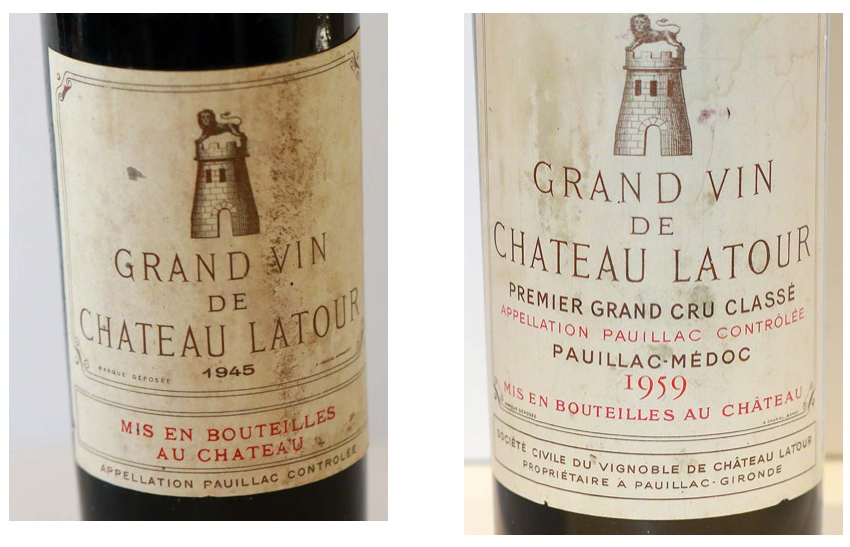
“SOCIETE CIVILE DU VIGNOBLE DE CHATEAU LATOUR
PROPRIETAIRE A PAUILLAC-GIRONDE”
thus adhering to the 1949 decree. Comparing this with pre-1949 vintages Château Latour, for example, 1945, there is no mention of the above. This is an important element to look for when checking Château Latour labels for authenticity.
France was a step ahead as it was only in the 1970s when European Community legislation made it mandatory for the bottlers name and address to appear on all labels on wine produced in the European Economic Community. This is often in the form of an agreed and registered bottlers code. However, the full name and address of the wine bottled at the estate still has to feature the labels on all French Appellation d’Origine Contrôlée wine.
French commercial and legal entities for agriculture and commerce are manifold. Given the many family holdings in Burgundy, it is not surprising to see on 1949 labels onwards the following mentions after the name of the owner:
“Viticulteur (s)”
“Propriétaire”
“Propriétaire-Viticulteur”
The principal legal designations for commercial entities owning vineyards in France are as follows:
Société Anonyme (S.A.). Established in French law since 1807 in the then “Code du Commerce”. This designation is necessary for a large company with a board of directors, a chief executive and able to trade its shares publicly on the stock exchange. Larger estates or Châteaux are more likely to be owned by such a Company (e.g. Château Haut Brion).
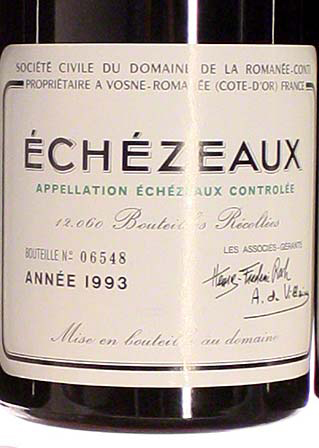
Société Civile (S.C.). Recognised by French Law in 1845. This is a non-commercial partnership and farming actually falls under this category in France. Therefore wine growers and winemakers can operate under such a structure (i.e Domaine de la Romanée Conti, Château Pétrus).
Société à Responsabilité Limitée (S.A.R.L). This is akin to a limited company and was created by French law on the 7th March 1925. This is one of the most common types of commercial concerns in France. There has to be a “gérant” (managing director) and there can be between 2 to 50 shareholders. (e.g. Château Olivier).
Groupement Agricole Exploiteurs Commun (G.A.E.C.). French law created this entity on the 8th August 1962. This is very suitable for an association of farmers growing the same product and then to commercialise it. The maximum number of farmers in this group is limited to 10. An example of this type of structure is : GAEC Domaine du Chardonnay in Chablis.
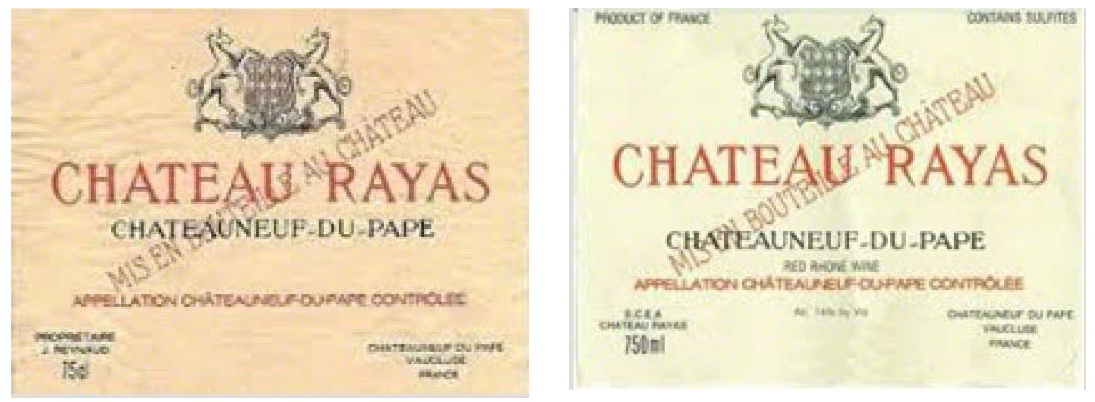
Société Civile d’Exploitation Agricole (S.C.E.A.). This structure was created by French law on the 3rd July 1978. It is not a limited company and must comprise at least two people. As the name implies, it was created to suit the needs of an agricultural concern. An example is S.C.E.A. Château Rayas.
Exploitation Agricole à Responsabilité Limitée (E.A.R.L.). Created by French Law on the 11th July 1985. 1 to 10 people can be part of this business. It has to be an agricultural concern. It was created chiefly to allow farming families to have a recognised business and is particularly suited to the family dynasties who own vineyards in Burgundy. An example is E.A.R.L. Domaine Sainson-Rossignol in Volnay.
Entreprise Universelle à Responsabilité Limitée (E.U.R.L.). Created by French Law on the 11th July 1986. Only one individual can operate under such a structure. It is most suitable for artisans who work on their own but individuals can operate under such a commercial structure in the wine world.
As one can see from above, the dates when these entities where established by the French legal administration provide important to us when looking at wine labels. It would be suspicious, for example, if the mention of the initials S.C.E.A. appeared on a label prior to the 1978 vintage. Knowledge of the evolution of a vineyard concern is also vital when reading a wine label. To give a specific example, Château Pétrus labels from the 1978 to 1999 should state the owner as
“Mme L.P. LACOSTE-LOUBAT
PROPRIETAIRE A POMEROL – GIRONDE (FRANCE)”
From the 2000 vintage onwards, it was decided that the owner designation should more correctly read:
“S.C. DU CHATEAU PETRUS
PROPRIETAIRE A POMEROL (GIRONDE) FRANCE”
Counterfeiters often get the company structure incorrect, or they fail to get the dates correct. For example, when Mr. J Renaud passed away, the structure of his company Chateau Rayas changed from a single ownership to an SCEA. However counterfeiters were several years off of that and change and have made labels from the time he was alive as SCEA labels, and labels after he passed away as Propriétaire J Renaud Labels.
Next Information Installments:
Legal requirements: Wine of Origin Laws
Glass- Food Packaging
Capsules- Food Packaging
Import Laws & Labels
Health Warnings
Producer History: Correct names for age can prove challenging to counterfeiters.
Label Designers & Printers can be a great source of authentic or counterfeit tells.
Artwork, Logos: Counterfeiters Achilles heel.
Placement on labels, capsules and corks matters.
Consistency