Greenberg vs Koch Trial: Part 3
By Siobhan Turner
Witness: Eric Greenberg
(Interesting… calling the defendant as the plaintiff’s second witness… My legal sources tell me this is about as rare as it gets. In fact, they hadn’t heard of it ever happening before.) Jason Abbruzzese of Mashable described Eric Greenberg as the “loudest rich guy in the room” (August 2015). The internet (former) billionaire favours wide pinstripes and conspicuous displays of his wealth.
John Hueston opened by stating that for years Eric Greenberg had bought wine from Rudy Kurniawan and placed stickers with the name “Rudy” on bottles from him because his wine was so good, and had extra special provenance. Greenberg agreed to all of this, and that it was rumoured that Kurniawan spent upwards of a million dollars a month at auctions. However, he had caught Rudy selling him fake wine in late 2003 – specifically, he had “bought bottles of wine from Wine Bid, consigned by Rudy Kurniawan, which were determined were not authentic”.
Eric Greenberg agreed he was livid he had got fake wine, but denied that it had anything to do with Kurniawan. Hueston stated that Greenberg had wanted restitution; Greenberg replied that he wanted his money back. He did not recall saying that he wanted the bottles destroyed, but did accept that he had written an email saying he wanted punitive damages and to destroy Kurniawan’s reputation, adding “sometimes I am hotheaded. I probably didn’t mean it.” (At this point, I am moved to write that it is a sincere pity that Greenberg did NOT seek punitive damages, or destroy his reputation. Had he done it back in 2003, there would be a LOT less fake wine on the market right now.)
Hueston produced an email, written between Eric Greenberg and Steve Griffin of Wine Bid in late December 2003, in which Greenberg stated that he knew “for a fact” the wines had been consigned by Rudy Kurniawan, and that Kurniawan had also consigned some bad magnums to Acker Merrall, that Greenberg had also bought. The email went on to say that he “can proceed with a lawsuit without messing around”, going for punitive damages, and to “bury the consignor’s reputation in the wine world” (If only he had done….) because there was “too much faking going on”. He asked Wine Bid to notify everyone who had bought wine consigned by Rudy to notify them that it may be suspect. He wanted his money back, and the wine destroyed, and to know where he got the bottles from. He did not, however, get the provenance information.
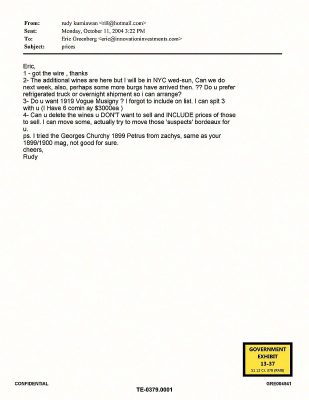
13-37 RK to EG SUSPECTS Bordeaux email
Despite all of the above, however, Greenberg continued to do business with Kurniawan, and as early as May 2004, less than six months from the Wine Bid emails, he was seeking Kurniawan’s co-operation, writing “you should call me when looking to move certain wines, and I should do the same for you. We would both be better off.” Greenberg denied (somewhat implausibly, I think) that this meant selling the fakes, but claimed that it meant that if he had known Rudy was selling certain wines Greenberg could have avoided the 20% buyer’s commission and just bought them direct.
Hueston then showed Greenberg an email dated 11 October 2004, in which Rudy Kurniawan offers “I can move some, actually try to move those “suspects” Bordeaux for you.” Greenberg claimed he did not know what “suspect” meant; although he had often used that very word for questionable or fake wine Greenberg he did so with quotation marks, and in the singular. Hueston noted that Greenberg did not ask for clarification on these items – he seemed to understand the word in both singular and plural, with or without quotation marks. Instead, Greenberg had responded that he was “putting it on auction”. Greenberg claimed this referred to an 1899 Petrus – in contrast to what he stated in his deposition. Greenberg claimed this was because he got confused, since it was his first deposition. He claimed he continued to do business with Rudy Kurniawan because he thought he had good wine – despite the Wine Bid fakes and the previous Acker Merrall fakes that had come from Rudy.
Hueston then moved to Eric Greenberg’s sale of wine through the Chicago Wine Company, including magnums of Petrus from the 1920s. Frank Cialone objected to an email between Greenberg and Simon Lambert of the Chicago Wine Company being presented as evidence; Judge Oetken accepted it on the basis that it was defined as hearsay, that is, it is not admitted for the truth of the matters asserted in the statements, but it can be relevant to establish motive, intent, or absence of mistake. In the email, Simon Lambert refers to a complaint from a customer who bought the 1921 and 1929 magnums, but rejected them because both bottles had corks with no date on them. Lambert had written, “Had either of these problems been apparent when I saw the photographs, we would not have offered them for sale.” Greenberg replied that he didn’t know what sort of lighting the person who looked at these had, but that as far as he was concerned, “they were wrong, but you know what, I stood behind my wine, as I always do, and I gave him a refund. He asked for a refund and I gave it. Just as if I was asked to refund for other wine, I would have given that refund (Aha! He’s managed to raise the issue of a refund….). I have nothing to hide.”
John Hueston then averred that the bottles were returned to Eric Greenberg and were added back into his inventory. Greenberg claimed this did not happen until he had “fully inspected them to make sure they had cork markings”. Hueston at this point submitted for evidence Greenberg’s wine inventory from 31st March 2005 showing three magnums of 1921 Petrus. Greenberg claimed repeatedly this showed three magnums of presumed authentic wine – because only authentic wine was in his inventory. Hueston confirmed that Greenberg had by this time taken the returns from the Chicago Wine Company for the three magnums of 1921 Petrus – so there was an inventory showing three magnums, and three magnums had been returned. (Bear with me – it gets more interesting…)
Hueston then showed Greenberg a second inventory, from 30th July 2005, with an updated inventory of “presumed authentic wines”. This also included three 1921 Petrus magnums, despite Zachy’s having taken two magnums. These two magnums were two of the three that came out of the inventory, and two of the three that came back from the Chicago Wine Company. Hueston noted that without his asking, Greenberg had “repeatedly blurted out that [he] looked at and found a vintage or a date on the cork. However, his own expert had not find a vintage or date on the bottles at issue, the 1921 Petrus that Koch had purchased. Greenberg claimed that “sometimes you will miss things.” Hueston handed Eric Greenberg his expert’s rebuttal report, prepared by Gil Lempert-Schwarz. Although the report discusses “legible branding” on the cork of this Petrus, there was no mention of seeing the vintage date on that cork. Michael Egan, the Koch expert, did not find a fate as the cork. Greenberg agreed that neither Lempert-Schwarz nor Egan had mentioned a date, but insisted that Zachy’s had found one.
John Hueston then asked Greenberg if he had told Zachy’s that the magnums he got back from Chicago “had in fact been rejected” by Chicago Wine. Greenberg replied that they had not been rejected; he had processed a refund. He did not tell Zachy’s about the refund because he thought they were real. Greenberg did not tell anyone at Zachy’s about the concerns raised in the email from the Chicago Wine Company because, in his mind, they were not credible.
Hueston then queried whether Eric Greenberg knew of Bordeaux Wine Locators; Greenberg confirmed he did not know them personally but did know of them. The wines in his collection that had Bordeaux Wine Locator strips would have been imported by then, and sold to him through another distributor or retailer; he had not had any individual commercial transactions with them. Greenberg agreed he had said that Bordeaux Wine Locators were some of the worst counterfeiters in the world, but he meant it as a joke.
Hueston presented an email to Dave Smydo, the CEO of fine wine merchant Sokolin, written 24th November 2004. In it, he complains about a bottle of 1949 Latour: “The cork is not properly marked, the bottle itself is suspect, and the label is taped on with cellophane…. I will expect a refund on that as well”. Greenberg agreed that he was serious about getting his money back. After this statement, Greenberg wrote “Bordeaux Wine Locators is the worst counterfeiting operation in the world”, but this he claimed was sarcasm, because he was friends with the people at BWL. He sold hundreds and hundreds of bottles via Zachy’s with the BWL strip on them.
Hueston then showed eight bottles, which Greenberg agreed all had the Bordeaux Wine Locators strip on them: two 1950 Petrus, five 1950 Lafleur Pomerol, and a 1945 Lafite. All eight were admitted to evidence.
Greenberg agreed he had not told Jeff Zacharia that he thought Bordeaux Wine Locators was the worst counterfeiting operation in the world, because he did not believe they were the worst counterfeiting operation in the world. He emphasised that his statement as such in his email was sarcasm, nothing more.
The jury was dismissed for the day.
There followed a brief discussion on the bifurcation, and allocation of time, and then the court was adjourned for the day.
Click here for Part 4.