Wine Industry Counterfeit Scope and Problem

Wine Industry Counterfeit Scope and Problem
By: Nick Bartman
China's wine imports grew rapidly
Whilst China has a 2,000 year history of making wine, it was not until the mid-1980s leader Deng Xiao Ping laid the corner stones that transformed the stumbling wine industry to compete with the mighty predominance of locally made rice wine and beer.
Wine production levels are now close to that of South Africa, and no one now doubts that Deng’s six years as a young adult in France majorly influenced his vision that the Chinese should have access to a more diverse range of drink options.
In stark contrast to Mao Zedong’s desperate form of communism and closed China obsessions of the 1950s to 1970’s, Deng’s Open Door Policy took root in the 1980s resulting in western habits and fashion gaining traction. Opportunities abounded and the staggering growth of the wine industry was underway.
Since then, particularly the past 8 years, the market in China has surged like no other on this planet. Approaching 10% yearly sales increases are recorded, despite a relatively slight knowledge of wine, and are predicted to increase year on year; a reflection of the extraordinary growth in personal affluence of a status conscious and driven nation.
However, one unexpected recent surprise has been a dramatic slowdown in the higher end wines caused, in part, by government’s graft crack down on high rolling public officials intertwining themselves with big business, whose collective penchant for exorbitant entertainment has been grandly torpedoed.
Affordable day-to-day wine now occupies centre stage, galvanised by the younger business types whose pockets are insufficiently deep for the more expensive wines. Imports remain strong helped firstly by the caché of being foreign, and secondly by the perpetual food and drink contamination and tampering scandals that have forced informed Chinese to distrust local product. Having said that, there is as much imported wine drunk, despite the price being that much greater due to shipping costs and duty.
Red wine is head and shoulders the stronger seller, sturdily supported by the bewildering fact that in Chinese culture the color red represents happiness, beauty, success and good fortune. White is barely recognised as a wine, and rosé completely baffles.
Now, mix all factors together and imagine how the unscrupulous vulture business community in China might see wine as a trick not to be missed: an exponentially growing market of customers with comparatively little knowledge, a product with undefinable precise properties and traceability, and many thousands of foreign brands to purloin.
The scope of illegal wine in China is a horror, but there are sadly not many legitimate wine importers, or merchants, prepared to actively help against this, for fear of reprisals. When working with the Chinese police, your writer approached one of the largest wine importers for some information, only for the meeting to be cut short and the revolving door spun by the boss whilst uttering the words “have you nothing better to do with your life?”. It must also be said that the wine media, in the region, have been singly unhelpful in publishing hard facts.
I have witnessed a multiplicity of frauds such as Chinese wine simply labelled up as a foreign brand, or low cost imported bottles that are then labelled up as prestige wine, as well as bulk flexi-tanks being imported from a low cost foreign region, to then be bottled and falsely sold as something vastly superior. For this purpose of this article, I deliberately leave out such crimes as the refilling of used bottles, and vintage date label changes.
Just one such fraud example was a Chinese wine importer in Yantai, Shandong Province, who bought a very entry level bulk table wine from Spain, shipped it in bond to France, where it remained in bond. The Spanish paperwork was disposed of, and French documentation created in order the evidence would show it was from Medoc. On arrival in China the documents were cleared by both the quarantine and customs departments, and then the paperwork duly banded about falsely authenticating the Medoc origin.
We spotted this irregularity as the glass bottle moulded inscriptions were those of a Chinese glass manufacturer, but empty glass bottles are not sold to France, as the specifications are different, and anyway the delivered prices are too high. The labels also unwisely claimed the wine was bottled at the chateau, which was impossible.
Away from China, just for a moment: one quite shattering recent revelation has been news that the hitherto respected French winery, Maison Fromont, for 10 years transported bulk wine from their various non-Chardonnay wineries, in different appellations, to Chablis for the wine to be bottled and labelled as such.
Then comes an Italian table wine incident in which the First Nations Winery of Canada imported circa 60 containers of bulk wine to Montreal, which was duly doctored using flavouring, bottled, and sold as Chianti.
Some 220,000 bottles of poor quality Italian wine, which had been stored in barrels to age as authentic Brunello di Montalcino, were seized fortunately before they could hit the market.
Just prior to this incident the authorities foiled a multimillion-euro Italian scam in which bulk table wine was being falsely labelled from the Italian tenor Andrea Bocelli’s estate.
And so the stories proliferate, but the reason for highlighting these actual crimes is they all have one element in common, that being tax irregularities which, ironically, was the very issue that locked away the most famous alcohol gangster of all time, Al Capone.
In a perfect world one might dream the villains detailed here would have been banged-to-rights for brand violations or good old down to earth fraud of the public, but in all incidents it was the tax authorities first through the door at 6am, waving handcuffs.
This tax issue will be discussed in greater depth on this website in time to come, but many of the problems of day-to-day drinking wine fraud could be substantially dampened by the tax authorities who impose bonded restrictions on the movement of wine, until tax is paid. From the moment a bulk wine leaves a winery it creates a paper-trail, and it is this one element that could lead to more wine fraudsters being brought to their knees.
As for China, conjuring up a profile of a wine counterfeiter might be an interesting test of imagination. One would be right to envisage a shabby building with an aged bottling line and pallets strewn around a dusty carpark. Perhaps just as easy to visualise would be an established and recognised operation succumbing to the trappings of easy money by running a twilight bottling shift. But stretching the mind to one of the oldest, largest and most reputable wineries in China might not be one to contemplate. For this, you would be wrong.
The story is this: I was in a restaurant cum bar, on the east coast of China, one evening desperate for a cigarette, the law relating to smoking at the bar having been imaginatively changed from an hour earlier. Outside a group of like minded outcasts were huddled from the chilly evening, the only foreigner amongst them offering a light as I patted my pockets.
He was Australian and, searching for conversation, soon shared his job details. He worked for one of the oldest, largest and most reputable wineries in China. Feet first, I queried if all his company’s wine was always Chinese, as claimed on bottles. Reason for asking is I had recently encountered a few glasses which did not have that derogatory mouth behaviour of an average Chinese red.
Back came the answer: no. I was drinking mainly Australian bulk wine, mixed with a drop of Chinese.
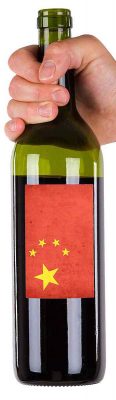
Wine labeled as Chinese produced
He explained the long term plan was to reverse the percentages in favour of the majority being Chinese, as wine making improved. But in the meantime, he bragged, the wine media, and others, were heralding the advancement of their wines, whilst the Australians were thrilled to be selling such substantial quantities. However, when I communicated, in very general terms, with Steve Guy at the Australian Wine and Brandy Corporation, the body that controls exports and origins, he hopped from one foot to the other with rage.
Australia is far from alone in their bulk wine being taken advantage of. Until the devastating Chilean earthquake of 2010, in which 125 million litres were wiped from the earth’s surface, they too had been a target of the Chinese, in part due to the production costs of their wine being lower than many. Spain, Italy and others have since been sucked into the problem.
In 2010 I gathered together all my experiences in China and estimated some 70% of all wine on the Chinese market was not as claimed on bottles. Back then it was easier determining fake from original due to absurd labels and other factors. The past five years the situation has improved, with much credit to the Chinese public enforcement authorities metaphorically turning their guns on offenders, however, determining the scale of the problem today is not so easy due to fakes elevating to counterfeits. Nevertheless, I am of the opinion that the market is probably still infested by some 50% illegal product.
The rule is very simple: whatever it says on a label, is what must be in the bottle. Any wine that deviates from this hard and fast principle is straight fraud.