Greenberg vs Koch Trial: Part 1
By Siobhan Turner
The case of Koch v. Greenberg began on March 26th, 2013.
Dramatis Personae:
Judge: J Paul Oetken
Plaintiff: William (Bill) I Koch
Defendant: Eric Greenberg et al.
Attorneys for plaintiff:
Edward M Spiro, Morvillo Abramowitz Grand Iason Anello
John Charles Huesten }
Moez Kaba } Irell & Manella, LLP
Marshall Camp }
Bruce A Wessel }
Attorneys for defendants:
Anthony Paul Coles, DLA Piper
Arthur J Shartsis }
Tracy Salisbury } Shartis Friese, LLP
Frank Albert Cialone }
Witnesses for the plaintiff (in order of appearance)
Day 2
Jamie Ritchie, Sotheby’s
Eric Greenberg, defendant
Day 3
Eric Greenberg, defendant (cont’d)
Day 4
Eric Greenberg, defendant (cont’d)
Day 5
Jamie Cortes
Maureen Downey, Chai Consulting and WineFraud.com
Day 6
William Koch, Plaintiff
Day 7
William Koch, Plaintiff (cont’d)
Mark Curley
Michael Egan
Day 8
Michael Egan (cont’d)
James Martin
Day 9
James Martin (cont’d)
Jeffrey Zacharia, Zachy’s
Day 10
William Edgerton
Brian Orcutt
Gil Lempert-Schwarz, Wine Institute of Las Vegas
Day 11
Gil Lempert-Schwarz (cont’d)
Background to the case
Bill Koch is an avid collector, and wine is one of his passions. He is believed to have spent over $12m amassing his cellar, much of which at Christie’s (see The Billionaire’s Vinegar), Acker Merrall & Condit and Zachy’s. Their auction catalogues, as was standard industry practice, contained language specifying that the purchaser bought the wines “as is” – that neither the auction house nor the consignor took responsibility for any aspect of the wine once purchased.
In 2007, Bill Koch brought a suit against Greenberg, Zachy’s and others for selling counterfeit wine, determined not to so much to recover his losses (he has spent far more in legal fees than any damages he recovered) but to raise awareness of fake wine, to change industry practices, and to rid the wine market of fake bottles. In 2011, he settled with Zachy’s. Although monetary terms have not been disclosed, Koch’s major win was to get Zachy’s to change their standard terms and conditions, so that they too absorbed responsibility for the sale of counterfeit bottles.
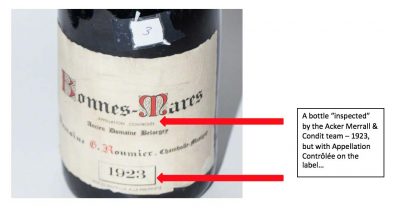
It took a further three years, a “substantial” financial settlement, and a guilty verdict for CEO John Kapon’s close friend and prolific consignor Rudy Kurniawan (see Rudy Kurniawan Trial) before Acker Merrall & Condit (AMC) settled with Koch. Kapon claimed AMC had always subjected pre-1962 wines to third-party inspection. If I were him, I would change my inspection team – at the very least to make sure they knew when the Appellation Contrôlée system started.
Day One: Tuesday 26th March, 2013
Day one began in open court, with no jury present, and Judge J Paul Oetken presiding. Judge Oetken is the first openly gay federal judge in the US, and looks remarkably like a younger version of John Malkovich – a comparison I suspect he cultivates. He noted that over the preceding days he had received many letters from both sides regarding certain matters relating to the trial, and he would address those first.
The first was that the judge had decided to permit evidence of Eric Greenberg’s refund offers to be allowed for limited purposes with reference to punitive damages, having concluded that these did not affect the validity or amount of Mr Koch’s fraud or GBL (General Business Law) claims, and that they were not fundamentally efforts to compromise a claim, but instead offers of a specific remedy. He also concluded that if evidence of these offers were excluded, it was the defendant, Eric Greenberg, who faced the greater danger of unfair prejudice, given the question of punitive damages. Justice Oetken emphasised, however, that the defence must not attempt to raise the offers of refunds as evidence against either liability or the overall validity of Bill Koch’s claim.
Justice Oetken then ruled that the (now amended – see above) “as is” disclaimer in the Zachy’s auction catalogue covered authenticity. This meant that the plaintiff (i.e. Bill Koch) must prove peculiar knowledge. Normally, parties to a contract, especially sophisticated parties such as Mr Koch, are expected to exercise a level of due diligence in their transactions – that is, to take reasonable care to make sure that, for example, they are buying what they think they are buying. However, this general principle of caveat emptor (“buyer beware”) falls down if an aggrieved party can prove peculiar knowledge – that is, that there was information both “known and knowable only to one party”, which renders false the counterparty’s basic assumptions about the transaction. Thus, the onus on Bill Koch was to prove that Eric Greenberg knew the wines were fake, and that he, Koch, could not have done before purchasing them.
Justice Oetken did, however, rule that there was an alternative to peculiar knowledge for Bill Koch, which was theory of scienter, guilty knowledge that is sufficient to charge a person with the consequences of his acts. That is, that Eric Greenberg had a “mental state embracing intent to deceive, manipulate or defraud” (US Supreme Court, Ernst & Ernst v. Hochfelder, 1976). If Koch could prove that Greenberg knew the wines were counterfeit and knowingly sold them on, this would prove fraud.
There was then a discussion of evidence which the defence had moved to exclude, including evidence showing links between Eric Greenberg, Royal (wine merchants) and Rudy Kurniawan. Justice Oetken agreed with the plaintiff’s lawyers that the specific emails they planned to raise showed motive, intent, knowledge and absence of mistake.
John Hueston, Koch’s lawyer, then asked for a moment to confer with his client. Hueston is a very attractive man, with thinking light brown hair and a slight build, dwarfed by his much larger-than-life (in every sense) client. Don’t be fooled – this is the Special Prosecutor on the Enron Task Force, who took down Jeffrey Skilling and Kenneth Lay with forensic detail, immense skill and utter ruthlessness.
Hueston and Koch were concerned that revealing the offer of a refund might prejudice the trial. They proposed first that there be a separate punitive damages phase where the question of a refund could be addressed. Hueston then added that if the judge was not inclined to allow a second phase, they will drop the punitive damages claim and keep the refund out. Justice Oetken questioned whether the case was not moot if the punitive damages were out of the picture, which Hueston denied. He noted that, per Judge Jones, Eric Greenberg had had, and still had, an opportunity to confess judgement, and the case could be moot by payment of damages. The key point is confessing to fraud; without this, the case is not moot.
Arthur Shartsis spoke at this point. Shartsis is an interesting man – a top notch lawyer at a small and fiercely independent practice in the Bay Area, which despite its size boasts clients including Oracle, Netflix, Lucasfilm and the states of California and Hawaii. As well as being de facto managing partner of the firm (it does not have the more conventional, rigidly hierarchical structure of most law firms), he has written two screenplays, travels the world, fly fishes and grows grapes in the Napa Valley.
With respect to the question of mootness, Shartsis emphasised that Eric Greenberg had offered to make Bill Koch whole, including interest, up to the time the lawsuit was filed. That offer, to refund the money that Koch is out for the 24 bottles in dispute, is still open. He expressed some frustration that seven years and millions of dollars later they were about to take two weeks in court for a matter worth $350,000, some of which had already been offset by the agreement with Zachy’s. Shartsis argued that the court should be fair to Eric Greenberg, and either go forward with the case as had previously been determined, or they would tender the money and moot the case. He continued to say that he thought it was an embarrassment to everyone that they could consume that amount of money – $14 million – and two weeks of court time, of jury time, for such a relatively small amount of money that could have been easily settled with payment in full for the loss Mr Koch had suffered.
Judge Oetken commented that he was surprised at the offer to withdraw the punitive damages claim, because that is what he thought the claim was about – damages to punish egregious behaviour.
John Huesten emphasised that the point was Greenberg had to admit liability; simply sending a cheque “and saying give us the bottles back” does not resolve the case. He argued, “This case is about somebody who pushed, and knowingly pushed, counterfeits into the marketplace, and that is important to have that brought to the public’s attention… Mr Koch wasn’t trying to pick a fight. Mr Koch has been trying to out a problem in this industry, and we firmly believe that Mr Greenberg’s been a part of this problem.” Hueston reiterated that if Eric Greenberg was ready to stipulate liability, then the case could be mooted, but otherwise, Shartsis was arguing that any issue of wrongdoing with nominal damages should be mooted. The question is accountability, and it is accountability that Bill Koch seeks and has done since the beginning. Strategic settlement offers are not the point; it is whether there was reckless or intentional reprehensible conduct that is the bottom line, not the amount of dollars.
The two attorneys then argued – somewhat fractiously – about what the level of costs were and should be for the case so far, and whether or not the case should go ahead as is, or with a bifurcated damages section. Justice Oetken decided to go ahead with jury selection while he pondered the question of bifurcation, but he did accept that the issue of a refund did only relate to punitive damages.
Jury selection began, with Eric Greenberg’s team using two jury consultants, Daniel Cooper and Susan Oliver. Jury consultants, often with expertise in human behaviour or psychology, advise a lawyer on selecting a jury, preparing opening and closing statements, how to question a particular witness to have the most impact on a jury, and on any issues that seem to have affected the jury particularly – testimony that might make them uncomfortable or emotional, perhaps.
A jury of eight was duly selected and sworn in, and sent for lunch, at which point the court discussed timings and returned to an extended and at times fractious argument on the question of bifurcation of punitive damages.
The court broke for lunch, and on its return, Judge Oetken gave the jury their preliminary instructions on the case, on what is and is not evidence, on how to conduct themselves through the trial, and on the burden of proof in a civil court. He then explained how the trial would be conducted, and summarised the stages it would go through.
He excused the jury for the rest of the day, and the two sided adjourned to two different rooms to see if they could reach an agreement without a trial.
Court was adjourned for the day.
Day Two: Wednesday 27th March 2013
The day opened with further legal arguments, in this instance the word arguments being used in its colloquial as well as its legal sense, about bifurcation and what evidence could be presented. Specifically, John Heuston (for Bill Koch) objected to the use of one of the 12 bottles that had been in the original 36-bottle complaint, but were now no longer included in it.
Judge Oetken then addressed the question of punitive damages, and the refund offers. He reminded both parties he had ruled that the refund offers were excluded for purposes of assessing liability, but that this ruling would be revisited if the plaintiff opened the door for it during liability arguments. He noted he had decided to bifurcate the trial, assuming that the door was not opened, so the first phase would be on liability and compensatory damages, and the second phase on punitive damages.
Arthur Shartsis then reminded the judge that Eric Greenberg’s refund offer had included a plan to have the bottles publicly tasted to determine veracity. (Side note: this was a completely nonsensical plan, not least because so many people’s palates had, by this time, been compromised by thinking they were drinking old Burgundy or Bordeaux, when their calibration was, in fact, based on Chateau Rodenstock and Domaine Kurniawan. The only two people I personally would trust to know some of the old Petrus vintages by taste alone are Serena Sutcliffe MW and David Peppercorn MW. Interestingly, they were two who walked out of Hardy Rodenstock’s famous tasting….) John Hueston reminded Judge Oetken that this was a mischaracterisation of the offer, which had been an offer for a charity wine tasting of bottles that were not included in the case under consideration. Shartsis argued that Greenberg was entitled to say that he believed the wines should be tasted for authenticity, and this has nothing to do with the refund offer.
Judge Oetken eventually ruled that it was acceptable in terms of displaying Greenberg’s willingness, but it could not be referenced in any way to a refund. He also reminded both parties that they each had 25 hours during the trial. If they were standing, that counted, be it direct or cross, and including the openings.
The two lawyers then argued (again) about the positioning of the rostrum, and the need, or otherwise, for a microphone. The jury were, eventually, brought in, and Judge Oetken reminded them they were about to hear opening statements, and that these were not evidence in the case.
Opening statement on behalf of the Plaintiff: John C Hueston
Hueston opened by saying that this was “a simple case about a seller who failed to disclose key information that any buyer would want to know” before a purchase. In October 2005 this seller put on a sale through Zachy’s of his wines “promoted as ‘17,000 Bottles of Greatness’”, a best of the best collection. However, the jury would hear that the seller knew of problems with his collection that made them worthless and not suitable for sale. The reason for the case is because he didn’t reveal this information, but instead got top dollar, including $300,000 for 24 of the more important bottles at issue in the trial.
Hueston showed the jury the auction catalogue, including a letter from Jeff Zacharia. It suggested that these were wines that could be traced right back to the European vineyards the wines came from, and Hueston emphasised that Greenberg had edited it and helped to craft it. In particular, he wanted to keep out the scale of the sale in proportion to his entire collection. Hueston noted that Bill Koch, unlike Eric Greenberg, was not in the business of buying and selling wine, but was simply a collector.
Hueston also emphasised that evidence that would show Greenberg knew he was selling fakes, including conversations with Serena Sutcliffe and Jamie Ritchie of Sotheby’s, a document he put together himself setting out the fakes he had bought from Royal Wine Merchants, and an authentication report from William Edgerton, together with conversations with his insurance companies to try to get some of the money back, and a draft of a lawsuit against Royal. There was even evidence that John Kapon of Acker Merrall & Condit refused some of these wines (which, given their Rudy Kurniawan track record, is really quite astonishing).
Hueston then laid out some of the tactics the defence would use to try to use to sway probability in their favour. They would say there was a disclaimer at the back of the auction catalogue – but this does not excuse not telling buyers the information they must know. They will claim that Mr Greenberg is a victim, that Mr Koch should have examined all 17,000 bottles himself – clearly not realistic, and not even possible when an expert takes on average 25 minutes per bottle to examine the wine, and the catalogue was sent only two weeks before the auction. Although the case centres on only 24 of the 17,000 bottles, these were some of the key trophy bottles that were on offer to lure buyers to come to the auction. These 24 bottles netted Eric Greenberg over $300,000, and both Mr Koch’s expert and Mr Greenberg’s agree that none of them is real, and none of them should have been put up for sale.
There was a short bathroom break, and then it was the turn of the Greenberg team.
Opening statement on behalf of the Defendant: Arthur Shartsis
Mr Shartsis rose to begin his opening statement, beginning with emphasising that the bottles were sold in a properly conducted auction, consistent with the way auctions are held, and they inspected the wines (as both parties agree); Mr Koch also had the opportunity to have his experts look at the wines he bought – which totalled 260 bottles for $3.7 million. They also rejected some, and it was Zachy’s who selected which bottles would be in the auction. The auction catalogue clearly says which information can be relied up on and what cannot. One bottle in the 70,000 in Eric Greenberg’s collection, of which 17,000 were being sold, was misfiled, and this bottle should not have been in the auction. But one in 17,000 is hardly a conspiracy.
Shartsis then went on to set out Bill Koch’s experience as an auction buyer and wine collector, noting that he has spent tens of millions of dollars on just about every different kind of rare thing, from paintings to Western memorabilia to wine. The fact that there is fake wine in the market is well known – Robert Parker wrote about it in Parker’s Wine Buying Guide published in 2002. Parker claims “With the technology available today, authentic-looking bottles, capsules, corks, and labels can be easily duplicated, and for these counterfeits, only a person who knows the taste of the wine could tell if the contents were bogus.” [To be frank, and with all due respect to Mr Parker, this is itself completely bogus.]
Shartsis then explained how experts authenticate wine, and all the different things they look at, from corks to bottles to sediment, and how difficult this is. He then explained how bottles are reconditioned (although he incorrectly described it, stating that “unknown wine” was poured into a bottle and it was then recorked. This never happens – bottles are only ever reconditioned with exactly the same wine. Authentic bottles, at least). Shartsis emphasised that Gil Lempert-Schwartz, Eric Greenberg’s expert, would say that tasting for authenticity is the only way to determine it, and that Mr Greenberg has always been willing to have the bottles tasted to see if they were real.
According to Shartsis, the reason that Eric Greenberg went with Zachy’s was not because they did not require him to stand behind his wines, but because it was his preferred company. The Sotheby’s contract he felt was unfair, and he didn’t like Christie’s head of wine auctions, Michael Broadbent, but he felt that Zachy’s was a big and yet innovative company, that sold good and reliable wine. He also had a track record with them: he had sold wine with them in six auctions before the one in question.
Shartsis then took the jury through the process of an auction, starting with the selection for sale, with the actual bottle pull being done by his assistant, Thierry Lovato. Jeff Zacharia and Fritz Hatton of Zachy’s then inspected the bottles, and made enquiries about provenance. Greenberg was always clear that he could not match bottle to source for any of his wines, and Koch never asked what the provenance was. Koch had tasted a magnum of 1921 Petrus that he knew was fake shortly before the auction, but he still bought this one, without raising any doubts about it at all.
Shartsis emphasised that the “as is” section of the contract clearly states that the buyer cannot rely on anything other than what has been explicitly stated in the catalogue, and his representative, who bid at the auction, signed that he would do so “subject to… the conditions of sale printed in the catalog”…
He then went on to explain how Greenberg started an investigation when he discovered that Royal might have sold him counterfeit wines, and he “had an assistant prepare a spreadsheet…. Here he has every invoice from Royal… and over here he notes whether he thought it might be fake.”… (Is it just me who finds this spreadsheet hard to square with a man who doesn’t know where his bottles came from?) He then used this spreadsheet to make an insurance claim, which was denied, and he then demanded some money from Royal, and received about $300,000, retaining the bottles. He was also very open about his problems with Royal, speaking about them with Zachy’s, Sotheby’s, Robert Parker and others. Shartsis then disputed whether or not the bottles in question actually came from Greenberg’s cellar.
Shartsis concluded by reminding the jury again of the “as is” provision in the contract, which he described as “no secret to Mr Koch and no secret to anybody” who buys at auction, especially since consumers have the right to inspect before purchase. He added that he was sorry for having gone on a long time (about 90 minutes), but he was confident that juries do try to do their best and, as a result of that, they would find “there is no hard evidence that Mr Greenberg intentionally [put a counterfeit wine into auction]”. (I find this phraseology interesting – “no hard evidence”… It sounds like he’s preparing the jury for the fact that there’s a heck of a lot of “soft” evidence.)
The jury was excused for lunch, at which point Judge Oetken asked if there was any progress on the discussions he had had with both sides about resolution. There was no progress.
Click here for Part 2.